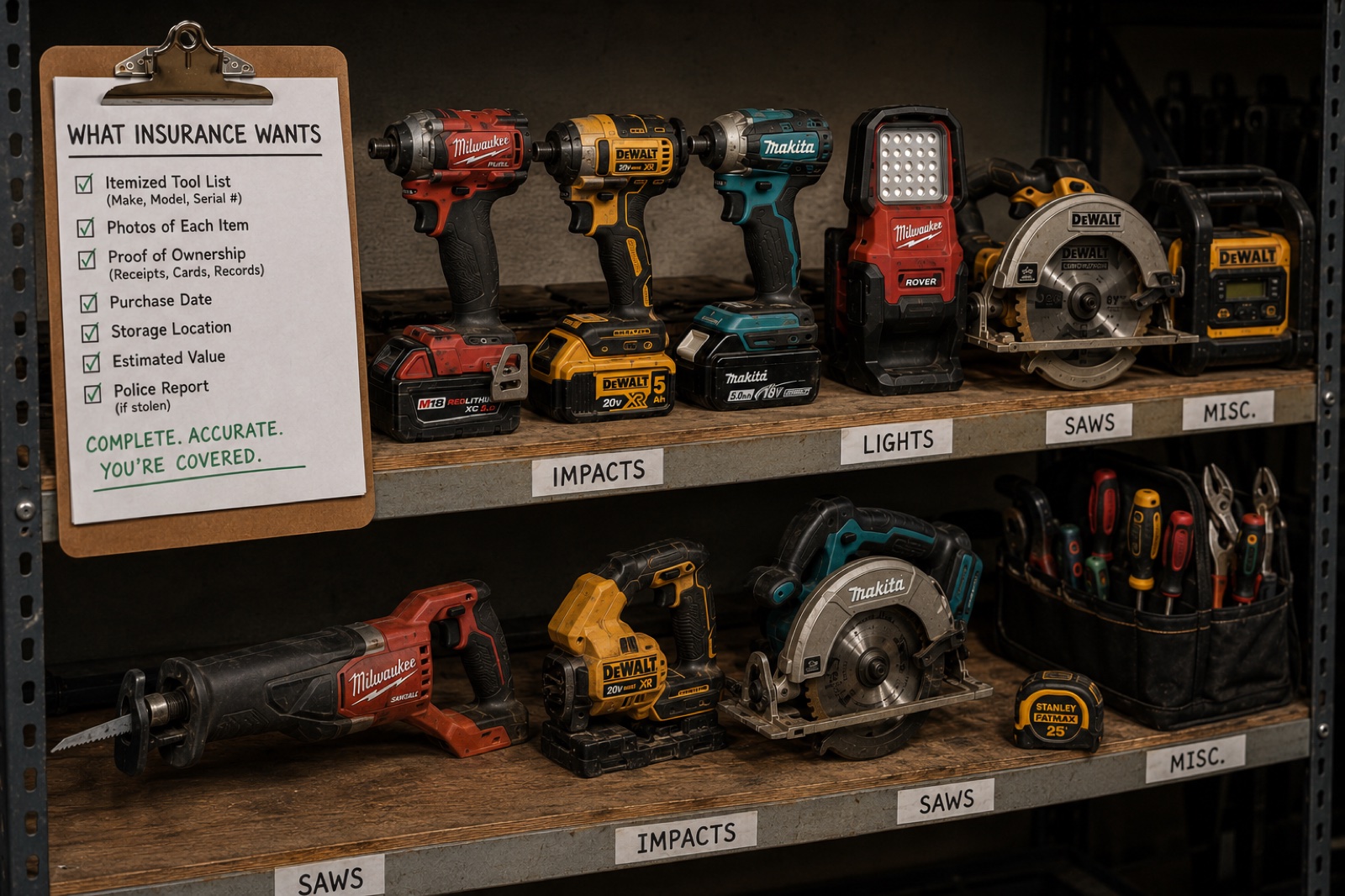
What Your Insurance Company Wants to See in a Tool Inventory
Insurance adjusters don't want a number on a napkin. Here's what they actually look for in a tool inventory — and why the contractors who get paid fast all do the same thing.
Most contractors insure their tools. Fewer contractors know what their insurance company actually expects when it's time to file a claim. The gap between "I have coverage" and "I got paid promptly and fairly" almost always comes down to documentation.
Talk to enough insurance adjusters and agents, and the same themes come up again and again. They're not asking for anything unreasonable. They just want organized, specific, verifiable information. The contractors who provide it get paid. The contractors who don't get delayed, lowballed, or both.
Here's what your insurer wants to see — and how to give it to them before you ever need to file a claim.
Itemization, Not Lump Sums
This is the single biggest mistake contractors make. They list their tools as a single line item: "Tools and equipment — $12,000." Then they're surprised when the adjuster pushes back or offers significantly less.
Insurance companies pay for specific items, not categories. They want to see every tool listed individually with:
- Brand and model. Not "drill" — "Milwaukee M18 FUEL 1/2-inch Hammer Drill, model 2904-22."
- Quantity. If you own three of the same battery, list all three.
- Condition. New, good, fair. Be honest — inflating condition hurts credibility on the whole claim.
Imagine the adjuster has to go buy replacements for everything on your list. Could they do it from what you've written? If the answer is yes, your inventory is specific enough. If they'd have to guess what you meant, it's not.
Photos of Everything
A written list is a start. Photos make it airtight.
Adjusters aren't suspicious people by nature, but they deal with fraud constantly. Photos shift your claim from "trust me" to "here's proof." They want to see:
- Individual tool photos. Clear enough to identify the brand, model, and general condition.
- Serial number photos. A close-up of the serial number plate or engraving. This is the single best piece of evidence for proving ownership of a specific tool.
- Context photos. Your truck loaded with tools. Your shop or trailer with everything in its place. These establish the scope of what you own and where it's stored.
- Timestamped photos. Photos with metadata showing when they were taken prove the tool existed in your possession as of that date. Phone photos include this automatically.
You don't need professional photography. A clear phone photo with good lighting is all it takes. The key is having a photo for every significant item — not just the expensive ones.
Serial Numbers
Serial numbers are the fingerprint of tool ownership. They uniquely identify a specific unit, and they can be verified against manufacturer records, warranty registrations, and even law enforcement databases for stolen property.
Record the serial number for every power tool, large hand tool, and piece of equipment worth more than a couple hundred dollars. Serial numbers are typically found on:
- A metal plate riveted to the tool housing
- An engraved or stamped area on the body
- A sticker (photograph these — stickers wear off over time)
- The battery compartment or handle area
Even for items without traditional serial numbers — some hand tools, accessories, and consumables — noting the brand and model is still valuable.
Replacement Values, Not Purchase Prices
This is where a lot of contractors accidentally shortchange themselves. Your insurer (if you have replacement cost coverage) wants to know what it would cost to buy an equivalent tool today, not what you paid for it three or five years ago.
Tool prices generally increase over time. The saw you bought for $500 in 2022 might cost $579 to replace today. Listing the original purchase price means you're under-insuring yourself from the start.
For each tool in your inventory, look up the current retail price from a major retailer or the manufacturer's website. That's your replacement value. Update these numbers annually — prices change, and your inventory should reflect current costs.
If your policy covers actual cash value instead of replacement cost, your insurer will apply depreciation. But they still want to know the current replacement price as the starting point for that calculation.
Organization by Location
Where your tools are stored matters for insurance purposes. Different locations may have different coverage levels, different risk profiles, and different policy requirements.
Organize your inventory by where tools are normally kept:
- Work truck or van. Tools that live in your vehicle full-time.
- Trailer. If you have a dedicated tool trailer.
- Shop or garage. Tools stored at your home or business location.
- Job site. Tools that move from site to site.
- Storage unit. If you use off-site storage for seasonal or backup equipment.
This organization helps your agent ensure you have appropriate coverage for each location and helps adjusters process claims faster when they can see exactly what was where.
Understanding Your Coverage: Scheduled vs. Blanket
Most tool coverage falls into two categories, and understanding the difference matters for how you build your inventory.
Blanket coverage insures all your tools up to a total dollar limit. You might have a $25,000 blanket policy covering everything in your truck and shop. The advantage is simplicity — you don't have to list every item. The disadvantage is that without itemization, proving what you owned and its value after a loss becomes much harder.
Scheduled coverage lists specific high-value items individually on your policy, each with its own insured value. Your $3,500 total station, your $2,000 laser level, your $8,000 set of pipe threading equipment — each appears as a line item with agreed-upon coverage. The advantage is certainty: if that item is stolen or destroyed, the payout is predetermined. The disadvantage is the administrative effort of keeping the schedule current.
Many contractors use a combination: scheduled coverage for high-value items and blanket coverage for everything else. Either way, a detailed inventory supports both types. With blanket coverage, it proves what you lost. With scheduled coverage, it helps you determine which items to schedule and at what values.
Inland Marine Policies: Coverage That Moves With Your Tools
If you're relying on a standard business property policy or a homeowner's rider to cover your tools, you might have a gap. Most property policies cover tools at a fixed location. If your tools are stolen from a job site, your truck, or anywhere other than your listed business address, you might not be covered.
Inland marine insurance is specifically designed for property that moves. Despite the name — which dates back to cargo shipping — it's the standard policy type for contractors' tools and equipment. It covers your tools wherever they are: in your truck, on a job site, in transit, at your shop.
When you talk to your insurance agent about tool coverage, ask specifically about inland marine. It's usually more affordable than contractors expect, especially when you can provide a documented inventory showing exactly what needs to be covered.
Your agent will set the coverage limit based on the total value of your inventory. Having an accurate, current inventory means your coverage matches your actual exposure — not too low (leaving you underinsured) and not too high (overpaying premiums).
Proactive Documentation Wins Every Time
The pattern across all of these requirements is the same: insurance companies reward preparation. The contractor who walks into a claim with a complete, organized, photo-verified inventory gets treated very differently from the one who shows up with vague estimates and no documentation.
Building that inventory doesn't have to be a weekend project. ToolTracked lets you photograph a tool and have AI identify it, then you add the serial number and replacement value. Five minutes per tool, and you've got documentation that satisfies every item on your insurer's wish list.
The time to build your inventory is not after a theft. It's not during your annual policy renewal. It's now — while everything is still in your truck and you can photograph it.
Your Inventory Checklist
For each tool in your inventory, your insurance company ideally wants:
- Brand name and specific model
- Serial number (if applicable)
- Clear photograph
- Current replacement value
- Purchase date (if known)
- Storage location
- Condition assessment
For your overall inventory:
- Organized by location
- Totals by category
- Annual update noting additions and removals
- Date of last review
No insurer will reject a claim because you're missing one field. But the more complete your inventory, the faster and smoother the process goes.
Give your insurance company exactly what they're looking for. ToolTracked helps you build a detailed, photo-verified tool inventory with AI recognition, serial number tracking, and insurance-ready PDF reports — all from your phone.