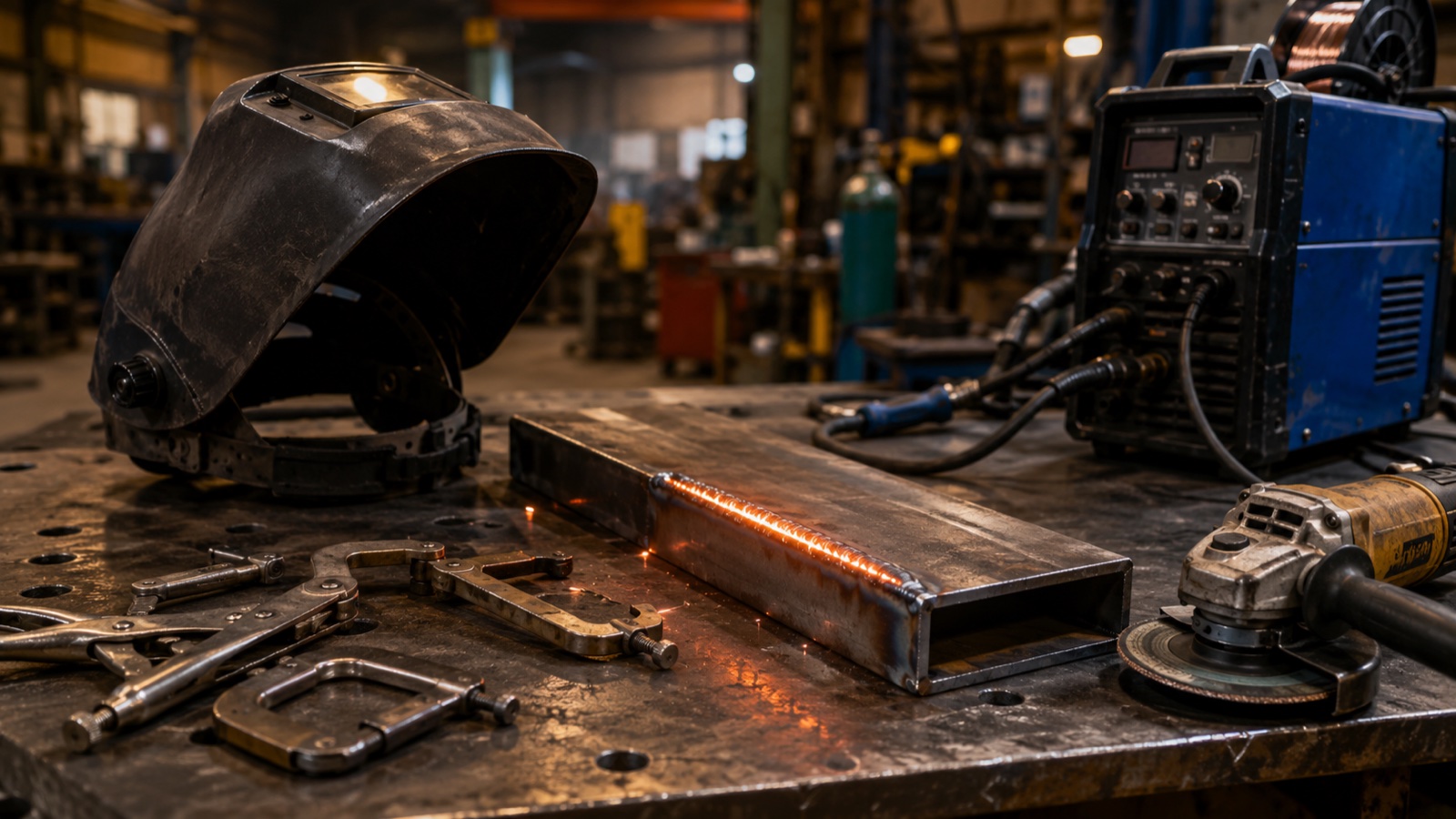
Welder's Guide to Tracking Tools and Equipment
Between the machines, the grinders, the gas cylinders, and the PPE you're supposed to replace every six months, welding has one of the hardest inventories to keep straight.
Welding is an expensive trade to equip. A single MIG welder runs $1,000 to $5,000. A TIG machine can be $2,000 to $10,000. A plasma cutter is $1,000 to $5,000. And that's just the primary machines — before you add grinders, clamps, gas cylinders, filler metals, PPE, and the hundred other items that make up a working welder's kit.
But here's what makes welding inventory uniquely complicated: a significant chunk of your equipment is consumable, rented, or shared between job sites. Gas cylinders are leased, not owned. Filler wire and electrodes get used up. PPE needs regular replacement for safety compliance. Grinding discs last days, not years. You need a system that tracks permanent equipment, consumable inventory, and rented items differently — because losing track of any of them costs you money.
What your toolkit is actually worth
Most welders guess $5,000 to $10,000. The actual range for an independent welder or small shop is typically $10,000 to $35,000 in owned equipment, with another $2,000 to $5,000 in rented or leased items at any given time.
The gap comes from the same place it does in every trade: accumulation. You don't buy everything at once. A grinder here, a clamp set there, a new auto-darkening hood when the old one gets scratched. By the time you've been welding for a decade, you've built up a serious collection — and most of it has never been written down.
The full inventory — permanent equipment
Welding machines
- MIG welder (Miller Millermatic 252, Lincoln Power MIG 260, Hobart Handler 210) — $1,000–$5,000
- TIG welder (Miller Dynasty 210, Lincoln Precision TIG 225, ESAB Rebel) — $2,000–$10,000
- Stick welder (Lincoln Tombstone / AC-225, Miller Thunderbolt) — $400–$2,000
- Multi-process welder (Miller Multimatic, Lincoln Power MIG Multi) — $2,000–$6,000
- Plasma cutter (Hypertherm Powermax 45, Miller Spectrum 625) — $1,000–$5,000
- Engine-driven welder/generator (Lincoln Ranger 330MPX, Miller Bobcat) — $3,000–$10,000
- Wire feeder (separate, for pipe work) — $500–$2,000
- Welding cart(s) — $100–$300
Total for machines: $3,000–$25,000+
An engine-driven welder like a Lincoln Ranger 330MPX is a $5,000 to $8,000 tool that goes on job sites, sits on trailers, and gets moved constantly. If it gets stolen and you don't have the serial number documented, recovering it is nearly impossible.
Grinders and cutting tools
Welders go through grinders like carpenters go through pencils. But the grinders themselves are a real investment:
- Angle grinder, 4-1/2" (DeWalt, Metabo, Milwaukee) — $60–$200 each
- Angle grinder, 6" or 9" — $100–$300
- Die grinder — $40–$150
- Bench grinder — $50–$200
- Cut-off saw / chop saw — $100–$400
- Porta-Band / portable band saw — $150–$350
- Grinding discs, flap discs, cut-off wheels (consumables, but stock has value)
Most welders own 2 to 4 angle grinders — one for grinding, one for cutting, one for flap disc work, maybe a backup. At $100 to $200 each, that's $400 to $800 in grinders alone.
Total for grinders/cutting: $500–$1,600
Clamps, fixtures, and setup tools
- Welding clamps (C-clamps, locking pliers, bar clamps) — $10–$60 each
- Magnetic squares / welding magnets (Strong Hand, Mag-Mate) — $15–$60 each
- Welding pliers / MIG pliers — $15–$40
- Fixture table (if shop-based, Siegmund, BuildPro, Certiflat) — $500–$5,000+
- Vises — $50–$300
- Squares (combination, engineer's) — $15–$100
- Levels — $15–$60
- Tape measures — $15–$35
- Soapstone holders and soapstone — $5–$15
- Chipping hammer(s) — $10–$25 each
- Wire brushes — $5–$15 each
- Welding blankets / fire blankets — $20–$80 each
Total: $500–$3,000
If you own a Siegmund or BuildPro fixture table, that's potentially $2,000 to $5,000 for the table alone, plus another $500 to $2,000 in clamps and fixtures that go with it.
Measuring and inspection tools
- Welding gauge set (bridge cam, fillet weld, undercut) — $30–$150
- Calipers — $20–$100
- Protractor / angle finder — $15–$50
- Contour gauge — $10–$30
- Inspection mirror — $10–$25
- Temperature sticks / Tempilstik — $5–$15 each
- Flashlight / inspection light — $20–$80
Total: $100–$450
Cordless tool platform
- Drill/driver — $100–$180
- Impact driver — $100–$200
- Reciprocating saw — $100–$200
- Work light — $50–$150
- Batteries and charger — $200–$500
Total: $550–$1,200
The permanent equipment total
- Welding machines: ~$8,000
- Grinders/cutting: ~$900
- Clamps/fixtures: ~$1,500
- Measuring/inspection: ~$250
- Cordless platform: ~$800
Typical total for permanent equipment: ~$11,500 for a mobile welder, $15,000–$35,000+ for a shop operation.
Rented and leased equipment
Here's where welding diverges from other trades: a meaningful portion of your working equipment isn't owned — it's rented or leased.
Gas cylinders
Most welders don't own their large gas cylinders. They lease them from the gas supplier (Airgas, Praxair/Linde, Matheson). But you're still responsible for them:
- Argon cylinder (large, 300 cf) — lease cost $50–$150/year, replacement value $200–$400
- CO2 cylinder — similar range
- Argon/CO2 mix (75/25) — similar range
- Oxygen cylinder — similar range
- Acetylene cylinder — similar range
- Small portable cylinders (owned) — $100–$300 each
You might have 3 to 8 cylinders on site at any given time. If one goes missing, you're responsible for the replacement cost to the supplier — typically $200 to $400 per cylinder. Tracking which cylinders you have and where they are matters.
Rented machines
For large jobs, you might rent specialty machines — a larger engine drive, a submerged arc setup, or a pipe welding rig. Tracking rented equipment separately from owned equipment keeps your records clean and ensures you return everything when the rental period ends.
Consumables — what's worth tracking
Not every consumable needs to be in your inventory. You don't need to track individual grinding discs. But some consumable categories represent enough inventory value to be worth monitoring:
Filler metals and wire. A spool of ER70S-6 MIG wire costs $30 to $80. A case of 7018 stick electrodes is $40 to $100. Specialty filler metals (stainless, aluminum, nickel alloy) can cost $100 to $500 per spool or package. If you keep $500 to $1,000 worth of filler on the shelf, that's inventory worth knowing about.
Tungsten electrodes. TIG tungstens are small and expensive. A pack of ten 3/32" 2% lanthanated tungstens is $15 to $30. If you keep multiple types and sizes, you might have $50 to $150 in tungsten alone.
Grinding and cutting discs in stock. A box of 25 cut-off wheels is $30 to $60. A box of flap discs is $40 to $80. If you buy in bulk, your disc inventory can be $100 to $300 at any given time.
Gas. Cylinder fills aren't cheap. A fill of argon can run $30 to $60. Having your current fill levels documented helps with job costing and prevents running out mid-project.
ToolTracked handles this distinction naturally — you can log permanent equipment with serial numbers and full detail, and track consumable stock separately with quantity and reorder notes.
PPE tracking — safety compliance
This is the part most welders skip, and it's the part that can actually get you hurt or in trouble on a job site.
What you should be tracking
- Auto-darkening welding helmet (Lincoln Viking, Miller Digital Infinity, 3M Speedglas) — $200–$500
- Backup helmet / fixed shade — $20–$80
- Welding jacket / leathers — $50–$200
- Welding gloves (MIG, TIG, stick — different for each) — $15–$60 per pair
- Safety glasses (shaded and clear) — $10–$40
- Hearing protection — $10–$50
- Respirator (for stainless, galvanized, or confined space work) — $30–$100
- Respirator filters — $10–$30 per set
- Steel-toe boots — $100–$250
- Fire-resistant clothing — $50–$200
- Welding cap(s) — $10–$25 each
Total for PPE: $500–$1,500
Why PPE tracking matters
An auto-darkening helmet with a scratched or slow-reacting lens is a safety hazard. Welding gloves with burn-throughs don't protect your hands. A respirator with old filters isn't filtering.
On union jobs and many commercial sites, safety inspections include PPE checks. If your helmet's auto-darkening sensors are damaged or your respirator filters are expired, you're not working that day.
Tracking your PPE with replacement dates and condition notes means you replace items before they fail, not after. A good auto-darkening helmet sensor should be tested periodically — manufacturers recommend replacement batteries and sensor checks on specific schedules. If your Miller Digital Infinity is three years old and you've never checked the sensors, it's time.
Insurance for welders
Machine coverage is essential. An engine-driven welder sitting on a trailer is a prime theft target. Make sure your inland marine policy covers all machines at their full replacement cost.
Specify high-value items. Any individual tool or machine worth more than your policy's per-item limit needs to be scheduled separately. A $6,000 TIG machine or a $7,000 engine drive almost certainly exceeds the default per-item limit on a standard policy.
Cover rented equipment. If a leased gas cylinder or rented machine is stolen from your site, you're liable for the replacement cost. Check whether your policy covers rented or leased items, or if you need a separate rider.
Job site vs. shop coverage. Welders work in both locations. Make sure your coverage follows your equipment to job sites, fabrication shops, and anywhere else it travels.
Build your inventory now
The best approach for welders:
- Start with machines — serial numbers, model numbers, purchase dates. These are your highest-value items and the easiest to document.
- Photograph your grinder collection, clamp drawer, and fixture setup. Group photos work well for mid-value items.
- List your current gas cylinder inventory with cylinder numbers (stamped on the cylinder).
- Document your PPE with approximate purchase or replacement dates.
- Note consumable stock levels — filler metals, tungstens, disc inventory.
Don't try to do it all at once. Machines and grinders first. Clamps and hand tools second. PPE and consumables third. Three sessions and you're done.
ToolTracked recognizes welding equipment from Miller, Lincoln, ESAB, Hypertherm, Hobart, Metabo, and hundreds of other brands. Snap a photo of your machine's data plate and the AI captures the details. Track permanent equipment, rented cylinders, and PPE replacement dates all in one place. Free for up to 20 tools. Download ToolTracked →