Tax Deductions for Contractor Tools: What You Need to Track
The tools you buy for work are tax deductible. But only if you can prove it. Here's what the IRS actually wants to see — and how organized contractors save thousands every year.
Every independent contractor knows that tools are a business expense. Fewer contractors know exactly how to deduct them correctly, and even fewer keep the kind of records that hold up if the IRS comes asking questions.
The difference between a contractor who deducts $3,000 in tools and one who deducts $15,000 isn't always spending — it's tracking. If you're not documenting your tool purchases properly, you're almost certainly leaving money on the table.
Here's how tool deductions actually work, what records you need to keep, and why your tool inventory might be the most valuable tax document you own.
Note: This is general information about tax deductions for tools and equipment. It is not tax advice. Your situation is unique, and you should consult a qualified tax professional for guidance specific to your business.
The Section 179 Deduction: Write It Off in Year One
Section 179 lets you deduct the full purchase price of qualifying equipment in the year you buy it, instead of spreading the deduction over several years through depreciation. For most independent contractors, this is the single most valuable tax provision you have access to.
The annual limit is generous — well into six figures for most tax years. That means your new truck, your trailer, your table saw, your entire cordless platform — all of it can potentially be written off in the year of purchase.
The key requirements: the equipment must be used for business more than 50% of the time, it must be put into service during the tax year you're claiming, and you need documentation proving both the purchase and the business use.
The De Minimis Safe Harbor: The $2,500 Rule
For tools and equipment costing $2,500 or less per item, the de minimis safe harbor election lets you deduct the full cost as an expense rather than capitalizing and depreciating it. This is separate from Section 179 and applies per item, per invoice.
That $400 impact driver? Expense it. The $1,800 miter saw? Expense it. A $2,200 rotary laser? Expense it.
You need to make this election on your tax return each year, and you need an invoice or receipt for each item. But for the majority of tools contractors buy, this is the simplest path to a deduction.
For items over $2,500 that you don't want to run through Section 179, you're looking at depreciation — which is where things get a little more involved.
Depreciation: Spreading the Cost Over Time
When a piece of equipment costs more than $2,500 and you choose not to use Section 179, you depreciate it over its useful life as defined by the IRS. Different categories of equipment have different depreciation schedules:
- 3-year property: Small tools and some specialized equipment
- 5-year property: Vehicles, trucks, computers, office equipment
- 7-year property: Most machinery, heavy equipment, fixtures
The IRS uses the Modified Accelerated Cost Recovery System (MACRS), which front-loads the deduction — you write off more in the early years and less later. This is usually advantageous because a dollar of deduction today is worth more than a dollar of deduction five years from now.
Bonus depreciation can also apply, allowing you to deduct a large percentage of an asset's cost in the first year on top of regular depreciation. The percentage and rules change frequently, so check the current year's rates with your tax professional.
What Records the IRS Wants to See
If you get audited — or even if you just want to file accurately — the IRS expects you to substantiate every deduction. For tool and equipment purchases, that means:
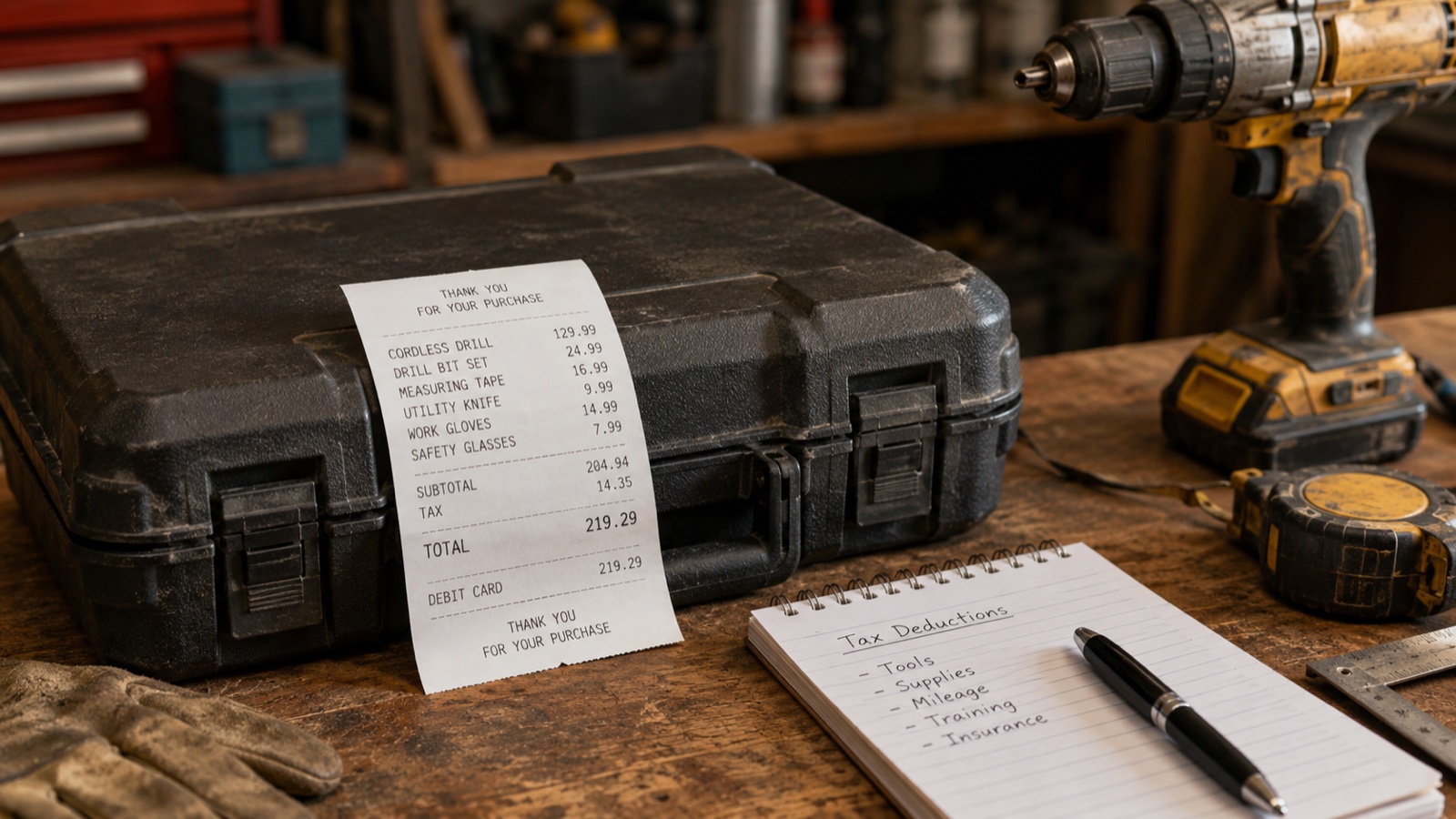
Proof of purchase. Receipts, invoices, credit card statements, or bank records showing the vendor, date, amount, and what was purchased. "Home Depot — $347.82" on a credit card statement is a start, but a receipt showing you bought a specific circular saw is much stronger.
Business use documentation. If a tool is used 100% for business, that's straightforward. But if you also use it for personal projects — say, a truck that doubles as your personal vehicle — you need to track and document the business-use percentage. The IRS is particularly aggressive about vehicles. Keep a mileage log or use a tracking app.
Date placed in service. The IRS wants to know when you started using the equipment for business, not just when you bought it. For most tools, the purchase date and the in-service date are the same. For larger equipment that takes time to set up, they might differ.
Asset list or inventory. The IRS doesn't explicitly require a tool inventory, but having one makes everything else easier. If you can show an organized list of every tool you own — with purchase dates, costs, serial numbers, and photos — your deductions become nearly bulletproof.
This is one reason a tool inventory app like ToolTracked pays for itself. Every tool you photograph and catalog is also a tax record: item, date, value, visual proof. When April rolls around, your inventory is your deduction list.
How Organized Contractors Save Thousands
Here's a scenario that plays out every tax season. Two electricians each spend $18,000 on tools and equipment during the year. Same spending, same business.
Contractor A has a shoebox full of crumpled receipts, half of which are faded beyond recognition. He remembers the big purchases but forgets the $80 here, $150 there that added up over twelve months. His tax preparer works with what's available, deducts $11,000, and moves on.
Contractor B tracked every purchase. She has digital receipts, an organized inventory, and clear records of what was bought when. Her tax preparer deducts the full $18,000. At a combined federal and self-employment tax rate in the 30-40% range, that extra $7,000 in deductions saves her somewhere around $2,000 to $2,800 in taxes.
Every single year.
Over a decade, that gap compounds into tens of thousands of dollars — money that Contractor A earned and spent on legitimate business expenses but couldn't deduct because he couldn't prove it.
Tools You Might Be Forgetting to Deduct
Most contractors remember the big purchases. It's the recurring and smaller expenses that slip through:
- Consumables and accessories: Drill bits, saw blades, sandpaper, fasteners, tape, caulk. These add up fast.
- Safety equipment: Hard hats, gloves, safety glasses, ear protection, hi-vis vests, steel-toe boots.
- Tool storage: Toolboxes, truck bed organizers, job site boxes, gang boxes.
- Subscriptions and apps: Tool tracking software, estimating apps, project management tools, plan reading apps.
- Maintenance and repair: Blade sharpening, calibration services, replacement batteries, charger replacements.
- Vehicle expenses: Truck payments, insurance, fuel, maintenance — either actual expenses or standard mileage rate.
- Phone and tablet: If you use it for business (photos, communication, estimating), the business-use percentage is deductible.
If you buy it because your business needs it, it's probably deductible. But only if you track it.
Setting Up a System That Works Year-Round
The contractors who maximize their deductions don't do anything heroic at tax time. They just have a simple system they follow all year:
Save every receipt digitally. Photograph paper receipts the day you get them. They fade, they get lost, they go through the wash. A phone photo stored in the cloud lasts forever.
Categorize as you go. Separate tools from materials from vehicle expenses. Your tax preparer will thank you, and you'll thank yourself when you're not spending a weekend in March sorting through a year's worth of purchases.
Keep a running inventory. Every new tool gets logged with the purchase date and cost. Every tool that gets replaced, lost, or broken gets noted. This running record is your asset list for depreciation and your proof of ownership for insurance.
Review quarterly. Spend 30 minutes every three months checking that your records are current. It's a lot easier to find a missing receipt from last month than from eleven months ago.
The Tax-Insurance Connection
Here's something most contractors don't think about: the same documentation that maximizes your tax deductions also maximizes your insurance claim if something goes wrong. Photos, serial numbers, purchase records, replacement values — your insurer and the IRS want almost identical information.
Building a thorough tool inventory isn't just organized. It's strategic. One set of records serves two critical financial purposes.
ToolTracked helps you build a complete tool inventory that doubles as tax documentation. Snap a photo, catalog it with AI, and have every tool's details ready for your tax preparer — or your insurance company. Start tracking at tooltracked.com.