How to Prove Tool Ownership Without Receipts
Lost your receipts? You're not out of luck. Here are seven ways to prove you owned tools — even without a single paper receipt in hand.
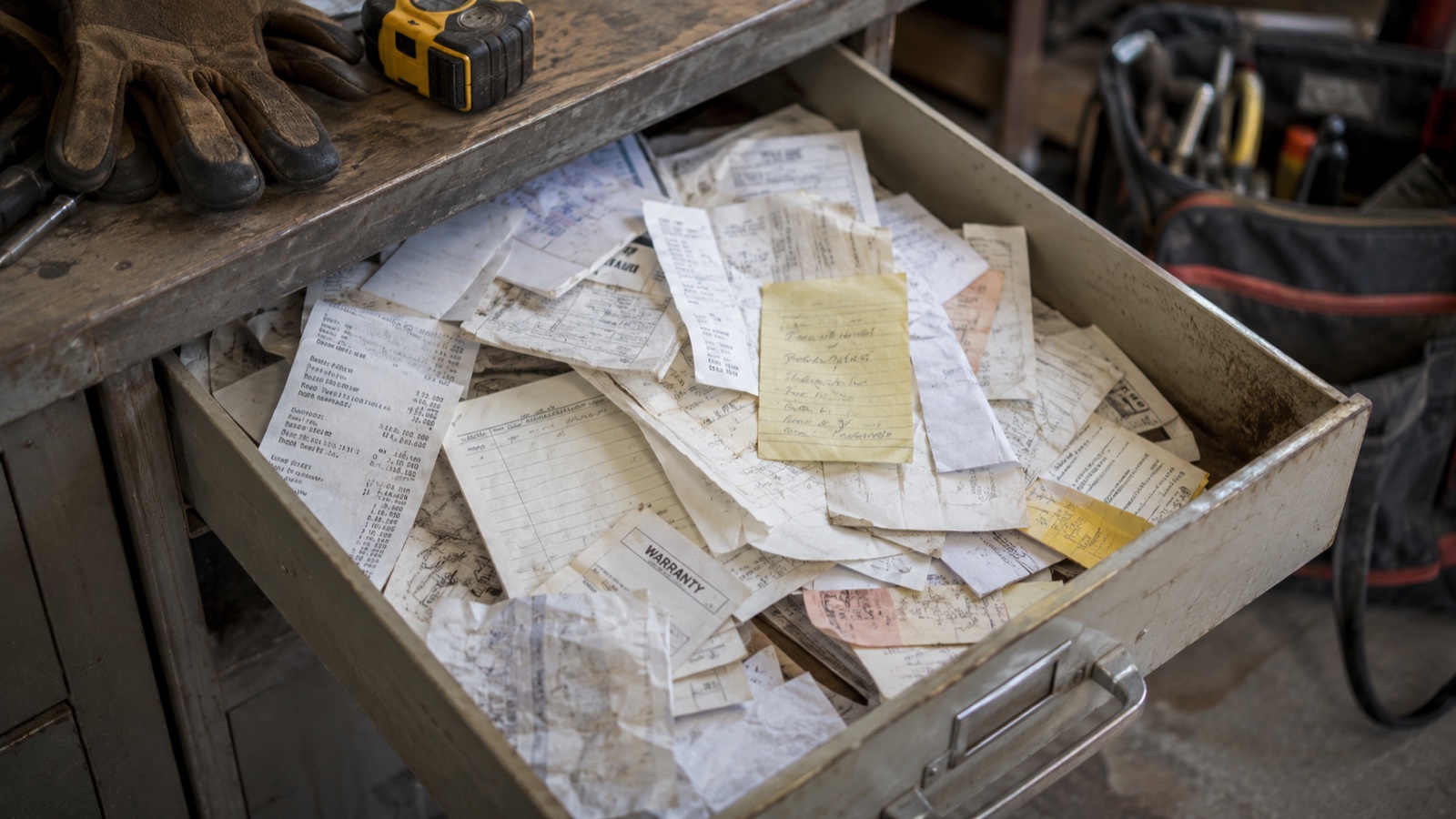
Receipts are the gold standard for proving you own something. But let's be honest — most contractors don't keep receipts for every $50 accessory, every battery, every hand tool bought on the way to a job site. And when you need to prove ownership for an insurance claim, a tax audit, or a dispute, that missing paper trail feels like a disaster.
It doesn't have to be. Receipts are one form of proof, but they're not the only form. Insurance adjusters and the IRS both accept multiple types of documentation, and if you're creative and thorough, you can build a strong ownership case without a single receipt.
Here's how.
1. Serial Number Records
Every major power tool has a serial number stamped or engraved on it. If you recorded those numbers — in a notebook, a spreadsheet, a note on your phone, anywhere — that's strong evidence of ownership. Nobody writes down serial numbers for tools they don't own.
Even if you didn't record them proactively, check a few places:
- Warranty registration emails. If you ever registered a tool online, the confirmation email likely includes the serial number.
- Manufacturer accounts. Milwaukee One-Key, DeWalt Tool Connect, Hilti ON!Track — if your tools are registered in any manufacturer platform, log in and screenshot your registered tool list. This is some of the strongest non-receipt proof available because it ties the serial number to your identity.
- Previous insurance documents. If you ever listed tools on a policy rider or scheduled coverage, those documents probably include serial numbers.
Going forward, record every serial number the day you buy a tool. It takes ten seconds and could save you thousands.
2. Photos With Timestamps
Your phone's camera roll is an underrated ownership document. Every photo you take has embedded metadata — date, time, and usually GPS coordinates. Photos of your tools, your truck, your job site, or your shop all count as evidence.
And it's not just deliberate tool photos. Think about:
- Job site progress photos. Those pictures you texted to your client showing work progress? Your tools are probably visible in the background.
- Social media posts. Scroll through your Instagram, Facebook, or TikTok. Contractors post their setups, their trucks, their new tools. Each post is timestamped and tied to your account.
- Photos sent via text or email. Search your message history. You've almost certainly sent someone a photo that includes your tools at some point.
The key is the timestamp. A photo of a tool proves nothing by itself. A photo of a tool on your truck bed, taken from your phone, dated six months before the theft, with GPS data placing it at your home address — that's compelling evidence.
3. Credit Card and Bank Statements
You may not have the receipt, but the transaction is still in your bank's records. Most banks and credit card companies let you download statements going back several years online.
A statement showing a charge at Home Depot, Lowe's, Acme Tools, or a specialty supplier on a specific date doesn't prove exactly what you bought — but it proves you spent money at a tool retailer. Paired with other evidence (like a photo of the tool from around the same date), it gets a lot stronger.
Contact your bank if online records don't go back far enough. Most institutions can pull transaction histories for seven years or more upon request.
4. Warranty Registrations and Manufacturer Accounts
This one is worth its own spotlight because it's the most underused proof of ownership available.
Major tool manufacturers maintain account systems that track your registered products:
- Milwaukee One-Key tracks registered tools, battery usage, and even tool location history.
- DeWalt keeps warranty registration records tied to your email.
- Makita, Bosch, Hilti, Ridgid — all maintain similar systems.
If you've ever registered a tool for warranty purposes, that record exists. It ties a specific tool (often by serial number) to your name, email, and registration date. Insurance adjusters treat manufacturer records as highly credible because there's no reason to register a tool you don't own.
Log into every manufacturer account you can think of and export or screenshot your registered tools. Do this now, even if you don't have an active claim. These records can disappear if a manufacturer changes platforms or if your account becomes inactive.
5. Purchase History From Retailers
Even without a paper receipt, your purchase history may exist digitally.
- Home Depot Pro Xtra members can access complete purchase histories tied to their account.
- Lowe's for Pros maintains similar records.
- Amazon keeps your complete order history indefinitely.
- Local supply houses often keep customer purchase records. Call and ask — many will print or email your history.
If you paid with a linked account, loyalty card, or business credit line, the retailer can usually pull your transactions even without a receipt number.
6. Witness Statements
People who've seen you use, buy, or possess your tools can provide statements supporting your ownership claim. This isn't as strong as documented proof, but insurance companies do accept it, especially when combined with other evidence.
Potential witnesses include:
- Coworkers or employees who used or saw the tools daily
- Clients who saw you working with specific equipment on their projects
- Fellow contractors you've worked alongside on job sites
- Family members who can attest to tools stored at your home
- Supply house employees who know you as a regular customer
A written statement with the witness's contact information, describing specific tools they saw you use or possess and the approximate dates, adds credibility to a claim that might otherwise lack documentation.
7. Business Records and Contracts
Your business paperwork can indirectly prove tool ownership:
- Job estimates and invoices that list equipment used or equipment charges
- Vehicle insurance covering tool storage in your truck or van
- Business loan applications that list assets
- Previous insurance applications where you declared tool values
- Business tax returns showing tool deductions from prior years
If you deducted a $3,000 table saw on last year's taxes, that's a record that you owned a $3,000 table saw. Your tax preparer can provide copies of filed returns if you don't have them.
How Insurance Adjusters Evaluate Claims Without Receipts
Understanding the adjuster's perspective helps you present a stronger case. When receipts aren't available, adjusters look for a preponderance of evidence — they don't need absolute proof, but they need enough documentation to believe your claim is legitimate and accurate.
They're evaluating three things:
Plausibility. Does the claim make sense for someone in your trade? An electrician claiming $15,000 in electrical tools is plausible. The same electrician claiming $15,000 in woodworking equipment raises questions.
Consistency. Do different pieces of evidence support the same story? If your bank statements show regular purchases at tool retailers, your photos show the tools on your truck, and your manufacturer accounts list registered products — that's a consistent, credible picture.
Specificity. Vague claims are weak claims. "Assorted Milwaukee tools" is vague. "Milwaukee M18 FUEL 1/2-inch hammer drill/driver, model 2904-20, purchased approximately June 2024" is specific. The more specific you are, the more credible you appear — and the fewer questions the adjuster needs to ask.
What You Can Do Right Now
If you're reading this because you need to prove ownership today, work through the seven sources above systematically. You'll probably recover more documentation than you expected.
If you're reading this because you want to be prepared, the best thing you can do is start building a documented inventory now. Photograph every tool you own. Record serial numbers. Save receipts digitally. An app like ToolTracked makes this fast — use AI photo recognition to catalog each tool, capture serial numbers, and build the kind of inventory that makes receipts almost unnecessary.
The contractors who never worry about lost receipts aren't better at keeping paper. They just have a system that doesn't depend on paper in the first place.
Build proof of ownership that doesn't depend on a shoebox full of receipts. ToolTracked uses AI photo recognition to catalog your tools, capture serial numbers, and create the documentation you need — before you need it.