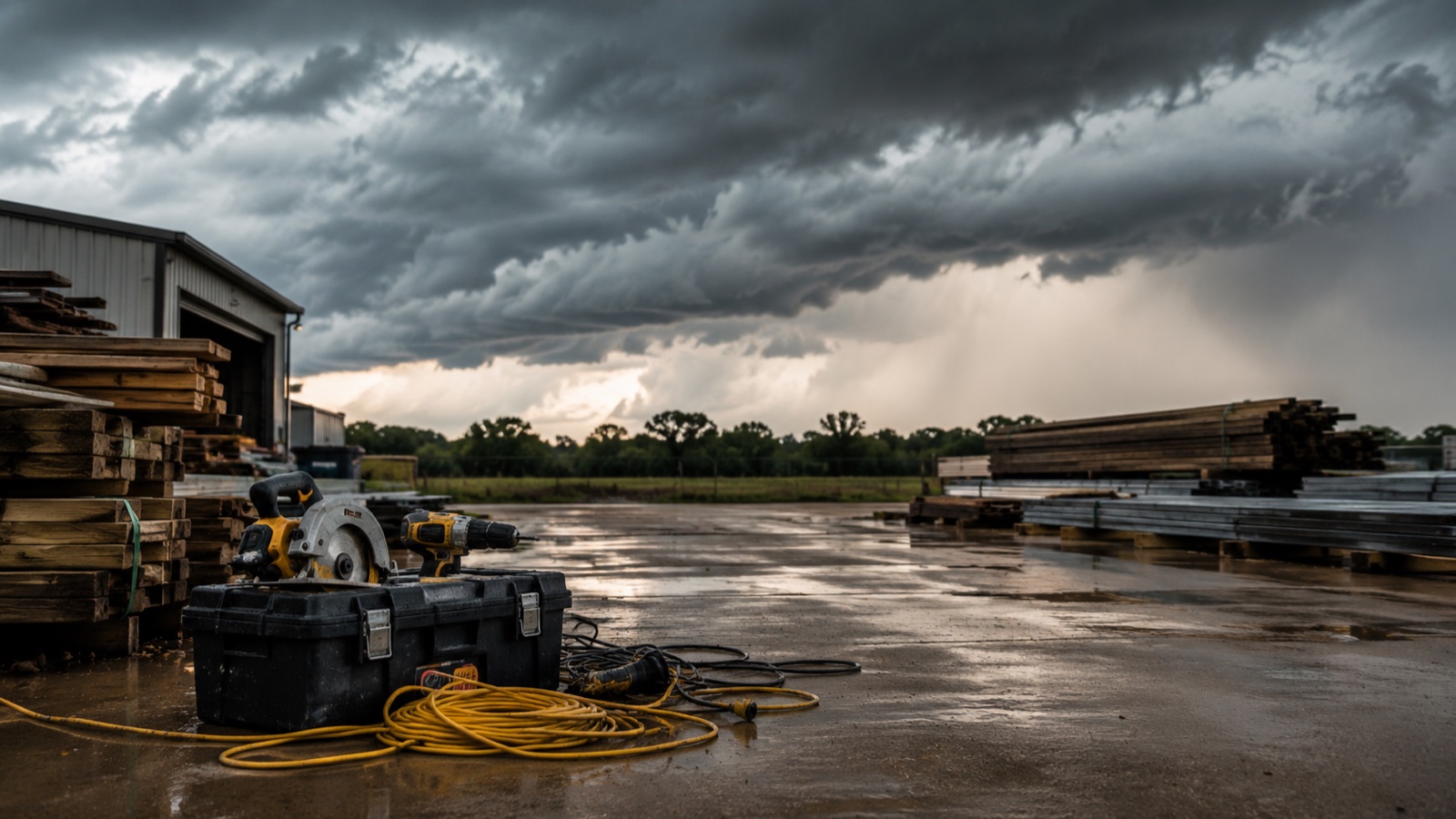
How to Prepare Your Tool Inventory Before Storm Season
Hurricanes, floods, and tornadoes don't send calendar invites. If you're a contractor in a storm-prone area, the time to prepare your inventory is before the weather gets bad — not after.
If you work in the Gulf Coast, the Southeast, Tornado Alley, or anywhere that nature likes to remind you who's in charge, you already know the drill. Storm season comes every year. You board up, stock up, and hope for the best.
But here's what a lot of contractors don't think about until it's too late: your tools and equipment are at risk too. And if a hurricane floods your shop, a tornado tears through your storage yard, or rising water swamps your truck, the difference between a fast recovery and a financial disaster often comes down to one thing — whether you documented what you owned before it happened.
This isn't theoretical. After every major storm, insurance adjusters and FEMA case workers deal with thousands of contractors who lost everything and can't prove what they had. The claims process is brutal even when you're prepared. Without documentation, it's nearly impossible.
Why contractors face unique storm risk
Most homeowners have their tools in a garage or basement. If those flood, they lose a toolbox and a lawn mower. That's a few hundred dollars.
Contractors lose their livelihood. A fully loaded work truck can carry $15,000 to $40,000 in tools and equipment. A shop can hold $50,000 or more. A storage yard with vehicles, trailers, and heavy equipment can represent six figures in assets.
When that gets destroyed, you can't work. And here's the painful irony: contractors are in highest demand immediately after major storms. Rebuilding starts fast, and the work is urgent, well-paying, and plentiful. The contractors who still have their tools can charge premium rates and stay booked for months. The contractors who lost their tools in the same storm are sidelined right when the market needs them most.
Every week you spend waiting on insurance money and replacing equipment is a week of lost income on top of the replacement cost itself. The financial hit is double — what you lost plus what you can't earn.
Before the storm: your preparation checklist
Storm season in the Atlantic typically runs June through November. Tornado season peaks in spring. Flood risk varies by region and can spike with heavy rain at any time of year. Whatever your local threat, do this work during the calm months.
Update your complete inventory
Go through every tool, piece of equipment, and vehicle you own. Make sure each item is in your inventory with:
- A clear, current photo
- Brand and model information
- Serial number (for power tools and major equipment)
- Purchase date or approximate age
- Current replacement value (not what you paid — what it costs to buy today)
If you've never built an inventory, now is the time. Don't wait until there's a storm in the forecast. The day a hurricane watch is issued, you'll be too busy securing job sites and prepping your own property to spend three hours photographing tools.
ToolTracked's AI photo recognition makes building an inventory fast enough to actually complete in an afternoon. Snap photos of your tools and the app handles identification automatically. The goal is reducing the barrier to entry so you actually finish the job before storm season arrives.
Photograph everything — even the obvious stuff
Take photos of your truck (exterior and interior, including the bed and toolbox contents), your shop (wide shots and detail shots of tools on walls, shelves, and benches), your trailer (with the door open showing contents), and any storage areas.
Photograph the serial number plates on major equipment. Photograph the VINs on vehicles and trailers. Photograph the inside of every toolbox drawer.
You're creating a visual record that proves what you owned and where it was stored. After a flood or wind event, this documentation is the foundation of your insurance claim.
Store your inventory report in the cloud
This one catches people. You diligently build a great inventory, save the PDF to your laptop, and the laptop is in your shop when the shop floods. Now your inventory documentation is destroyed along with everything it was documenting.
Export your inventory as a PDF and store it somewhere that isn't in the storm's path:
- Email it to yourself (it lives on the email server forever)
- Upload it to Google Drive, Dropbox, or iCloud
- Send a copy to your insurance agent
- Send a copy to your accountant
- Send a copy to a family member in a different region
If you're using a cloud-synced app, your data is already backed up automatically. But having a PDF copy in multiple locations is cheap insurance on your insurance documentation.
Review your insurance coverage
Pull out your policies and answer these questions:
What's your coverage limit for tools and equipment? If your inventory is worth $35,000 and your inland marine policy maxes out at $20,000, you have a $15,000 problem. Now is the time to increase your coverage, not after the storm.
Does your policy cover flood damage? Standard business property and inland marine policies often exclude flood damage. You may need a separate flood insurance policy through FEMA's National Flood Insurance Program or a private insurer. If you're in a flood zone, this is critical.
Does your policy cover wind damage? In hurricane-prone areas, some policies have separate wind/hail deductibles that are percentage-based rather than flat amounts. A 2% deductible on a $200,000 building is a $4,000 out-of-pocket cost. Know your numbers.
What's your deductible? Know the exact amount you'll pay out of pocket before insurance kicks in. For each policy. Some contractors carry multiple policies with different deductibles and don't realize the total exposure until they're filing claims.
Is your declared value current? If you told your insurer your tools were worth $20,000 two years ago but you've since bought $15,000 in new equipment, your declared value is wrong. Update it now.
Call your agent. Have this conversation. It takes twenty minutes and could save you tens of thousands of dollars.
Know your deductibles and cash reserves
After a major storm, you'll need cash immediately — to replace essential tools, repair your vehicle, and get back to work. Insurance claims take time. Even fast claims take weeks. Complex ones take months.
Make sure you have enough cash reserves or credit access to cover your deductibles and buy essential replacement tools before the insurance money arrives. The contractors who recover fastest are the ones who can buy a basic toolkit within days of the storm and start taking on rebuilding work while their full claim is still processing.
After the storm: how documentation changes everything
When the storm passes and you're assessing damage, here's how a pre-existing inventory transforms the recovery process.
Insurance claims move faster
An adjuster processing a storm claim wants documentation. Photos, serial numbers, replacement values, a clear list of what was lost. If you hand them a PDF report that was generated before the storm, they don't have to take your word for anything. The evidence is right there, time-stamped and detailed.
Contractors without documentation face a much harder process. The adjuster has to rely on your memory, whatever receipts you can dig up, and their own assessment. This takes longer, produces lower payouts, and leaves more room for disputes.
FEMA claims require proof
If your area receives a federal disaster declaration, you may be eligible for FEMA assistance on top of your insurance. FEMA's application process requires documentation of losses. A pre-existing inventory with photos and values gives you exactly what they need.
Without it, you're filling out forms from memory and hoping FEMA accepts your estimates. They often don't — at least not without significant back-and-forth and delays.
You can identify what's missing immediately
After a storm, your work area may be chaotic. Tools scattered, equipment displaced, some items buried under debris. Having a complete pre-storm inventory lets you check items off systematically instead of trying to remember what was where.
This also prevents the slow-drip discovery problem, where you realize weeks later that a tool is missing and your claim is already settled. If you have a complete list, you can verify everything against it before you sign off on the claim.
The timing matters
There's a reason this article says "before" storm season and not "during."
When a storm is two days out, you're busy. You're securing job sites, moving equipment to high ground, boarding up your shop, and prepping your own home. You don't have time to spend three hours photographing tools and building an inventory from scratch.
When a storm has just passed, you're even busier. You're assessing damage, filing claims, and trying to get back to work as fast as possible. Building an inventory after the loss is an exercise in frustration and incomplete memory.
The window is now. During the quiet months. When there's no urgency, no stress, and no deadline.
Set aside one afternoon. Walk through your shop, your truck, your storage. Photograph everything. Record serial numbers. Update replacement values. Export your report. Store it in the cloud. Review your insurance.
That afternoon of work protects you for the entire storm season. And if nothing happens this year — great. Your inventory is ready for next year too, with just a quick update.
The contractors who bounce back
After every major hurricane, every serious flood, every tornado outbreak, the same pattern plays out. Some contractors are back on the job within a week. Others are sidelined for months.
The difference isn't luck. It's preparation. The contractors who recover fast had their documentation ready, their insurance current, and their cash reserves in place. They filed clean claims, got paid faster, and replaced their tools while the work was plentiful.
The contractors who struggled were starting from zero — trying to prove what they owned, fighting with adjusters over values, waiting months for checks that came in lower than expected.
You get to choose which group you're in. And you make that choice before the storm, not after.
ToolTracked helps contractors build a storm-ready tool inventory with AI photo recognition, cloud-synced backup, and one-tap PDF reports for insurance and FEMA claims. Don't wait for the forecast to turn bad — start at tooltracked.com.