Plumber's Guide to Tool Inventory Management
Your tools are spread across two trucks, a garage shelf, and that one job site you forgot about. Here's how to get it all documented before something goes missing.
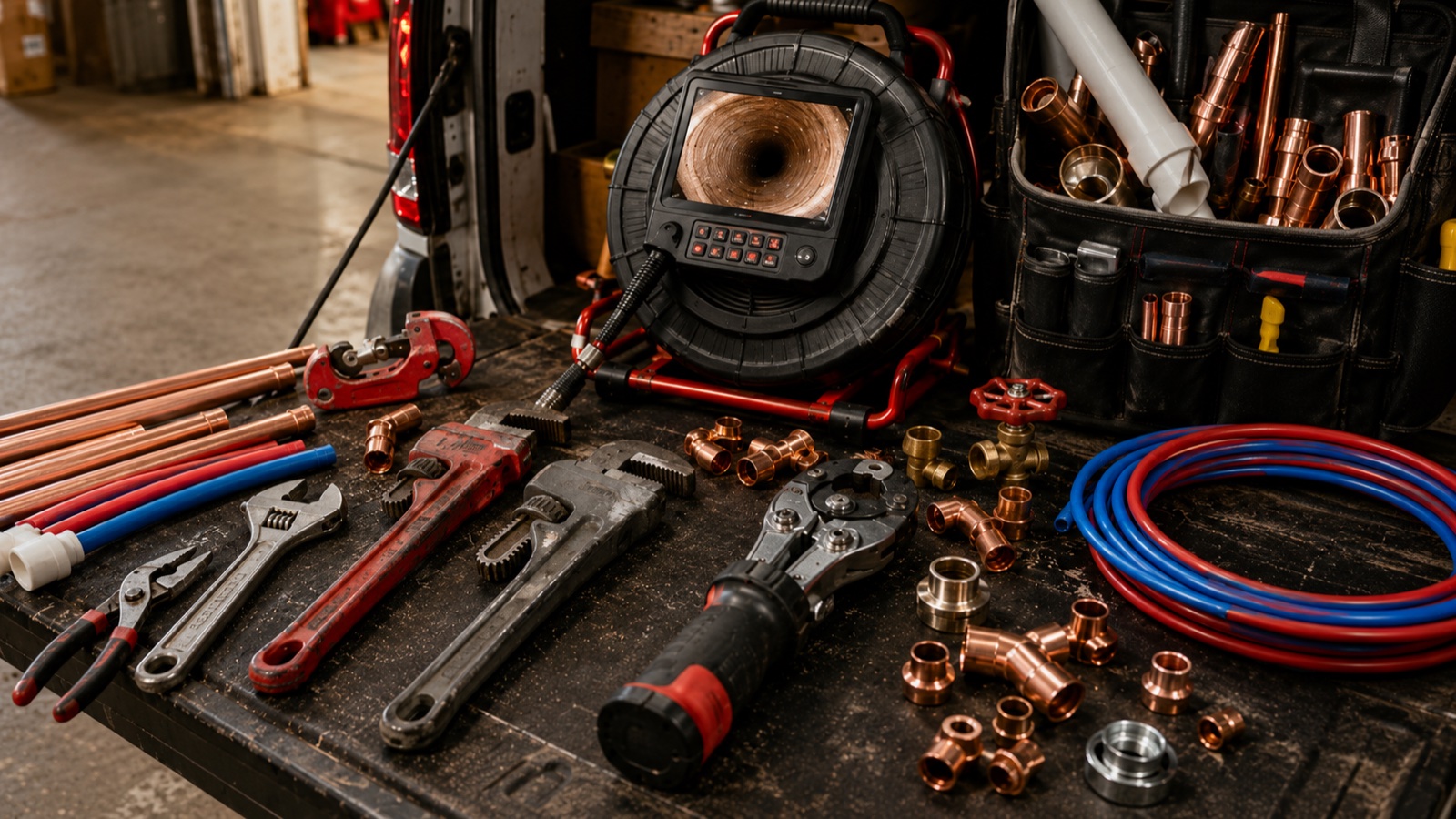
Plumbing is one of the trades where your tool collection never stops growing. You start with basic hand tools, then you buy a cordless platform, then specialty tools start creeping in — a press tool here, a drain camera there — and before you know it, you're carrying $15,000 worth of equipment across multiple vehicles and job sites without a single record of any of it.
The problem isn't just that plumbing tools are expensive. It's that they're specialized. When your pipe wrench gets stolen from a job site, you can't borrow one from the electrician working next to you. When your PEX crimping tool disappears, you can't run to Home Depot and grab one off the shelf. You're either ordering online and waiting, or you're paying a premium at a supply house while a job sits idle.
This guide covers what plumbers should be tracking, how to value it, and why the multi-location problem makes plumbing inventory uniquely difficult.
What your toolkit is actually worth
Most plumbers guess their tools are worth $5,000 to $8,000. The actual number for an experienced service plumber or small shop owner is usually $10,000 to $25,000 — and significantly more if you own drain cleaning equipment or a camera system.
The disconnect comes from two places. First, plumbers buy tools gradually, so there's no single moment where the total hits you. Second, many plumbing-specific tools are in that $300 to $2,000 range where they're expensive enough to matter but not expensive enough that you'd think to insure them individually.
The full inventory — what to count
Pipe wrenches and hand tools
This is the foundation. A working plumber's hand tool collection typically includes:
- Pipe wrenches — multiple sizes, 10" through 24" (Ridgid, Reed) — $40–$120 each
- Basin wrench — $25–$50
- Adjustable wrenches — multiple sizes — $15–$40 each
- Tongue-and-groove pliers — multiple sizes (Knipex Cobra, Channellock) — $25–$60 each
- Tubing cutters — copper and PVC, multiple sizes — $15–$80 each
- Pipe cutters (ratcheting) — $30–$80
- Hacksaw — $15–$30
- Torpedo level — $20–$50
- Tape measure(s) — $15–$35 each
- Plumber's torch and tip set (Bernzomatic, TurboTorch) — $40–$120
- Deburring tool / reamer — $10–$30
- Teflon tape, pipe dope, solder, flux (consumables but they add up)
Total for hand tools: $400–$1,000
You probably own three or four pipe wrenches of different sizes, and a good Ridgid 18" aluminum straight pipe wrench runs $70–$90. These aren't glamorous, but they're not cheap either.
Cordless tool platform
Same as other trades — one battery platform, multiple tools:
- Drill/driver — $100–$180
- Impact driver — $100–$200
- Reciprocating saw (essential for plumbing demo) — $100–$200
- Right-angle drill (for drilling through joists) — $150–$250
- Oscillating multi-tool — $100–$200
- Band saw (for cutting pipe) — $200–$350
- Work light — $50–$150
- Batteries (4–6 batteries at $80–$150 each) — $320–$900
- Charger(s) — $50–$100
Total for cordless platform: $1,200–$2,500
Press tools and PEX equipment
This is where plumbing gets expensive fast:
- Press tool (Milwaukee M12 Force Logic, Ridgid RP 351) — $1,500–$3,500
- Press jaw sets (multiple sizes) — $200–$600 per set
- PEX crimping tool — $50–$150
- PEX expansion tool (Uponor, Milwaukee) — $300–$500
- PEX rings, fittings (consumables but worth tracking the tools)
Total: $2,000–$5,000
A single press tool with two jaw sets can easily run $2,500. That's one tool. And if it gets stolen or breaks, you can't do press fittings until it's replaced — which means you can't work.
Drain cleaning equipment
Not every plumber does drain cleaning, but if you do, the investment is substantial:
- Handheld drain snake / drum machine — $200–$500
- Sectional drain machine (Ridgid K-60, General Wire) — $800–$2,500
- Drain camera / inspection system (Ridgid SeeSnake, etc.) — $2,000–$15,000
- Locator for camera system — $1,000–$5,000
- Jetters (if applicable) — $2,000–$10,000
Total: $2,000–$15,000+
A Ridgid SeeSnake camera system with a locator can cost $8,000 to $15,000. That's a single tool system worth more than some plumbers' entire remaining inventory. If you own one and it's not documented, that's a serious gap.
Soldering and brazing equipment
- Soldering torch kit (propane/MAPP gas) — $40–$120
- Brazing outfit (oxy-acetylene, if you do refrigeration crossover) — $300–$800
- Fire blanket / heat shield — $15–$40
- Tip cleaners, strikers, spare tips — $20–$50
Total: $75–$1,000
Testing and specialty tools
- Pressure test kit — $50–$200
- Pipe threading set (manual or powered) — $200–$2,000
- Cast iron snap cutters — $200–$600
- Propress prep tools — $30–$80
- Stud finder — $20–$60
- Inspection mirror — $10–$25
- Pipe locator — $200–$1,000
Total: $300–$2,000
Safety and work gear
- Tool bags and organizer systems — $50–$300
- Knee pads (you use these more than any other trade) — $30–$80
- Safety glasses — $10–$30
- Gloves — $15–$40
- Headlamp — $25–$80
- Hard hat — $15–$60
Total: $150–$600
The running total
Adding up the midpoints:
- Hand tools: ~$700
- Cordless platform: ~$1,800
- Press tools / PEX: ~$3,500
- Drain cleaning (if applicable): ~$5,000
- Soldering/brazing: ~$400
- Testing/specialty: ~$800
- Safety/work gear: ~$350
Typical total: ~$7,500 without drain cleaning equipment, $12,000–$20,000+ with it.
The multi-vehicle, multi-location problem
Here's what makes plumbing inventory harder than most trades: your tools are never all in one place.
A typical service plumber might have tools spread across a primary service van, a secondary truck for larger jobs, a home garage or shop where backup tools live, the supply house where a tool is out for repair, and whatever job site you're currently working.
When tools live in five places, your mental inventory is basically useless. You think your second set of press jaws is in the van, but it's actually at the shop. Your backup drain snake is — where, exactly?
This is where a tool tracking app pays for itself. With ToolTracked, you can tag each tool with its location and update it when things move between vehicles or sites. It turns the chaos of "it's somewhere" into a searchable record.
Insurance challenges specific to plumbers
Plumbers face some unique insurance headaches:
High-value single items. A drain camera or press tool system can be worth $5,000 to $15,000. Many inland marine policies have per-item limits of $2,500 or $5,000 unless you schedule items individually. If you don't specifically list that SeeSnake system, you may only recover a fraction of its value.
Tools in multiple vehicles. Some policies cover tools only in a specified vehicle. If you move your press tool to your second truck and that truck gets broken into, your claim might be denied. Check whether your coverage follows the tools or is tied to a specific vehicle.
Job site theft is common. Plumbing rough-in work means your tools are sitting in an open construction site, often overnight. Pipe wrenches and cordless tools are easy targets. Make sure your policy covers theft from job sites, not just from locked vehicles.
Replacement cost vs. actual cash value. A five-year-old Ridgid SeeSnake camera still costs nearly the same to replace as a new one. Make sure your policy pays replacement cost, not depreciated value. Specialized plumbing tools hold their value better than most trades realize.
Rented and borrowed equipment. If you rent a larger drain machine or jetter for specific jobs, check whether your policy covers rented equipment or if you need a separate rider.
How to build your inventory
Go vehicle by vehicle. Don't try to remember everything. Walk to your van and photograph what's in it. Move to your truck. Move to your shop. Location-by-location is the only way to catch everything.
Start with high-value items. Press tools, drain cameras, cordless platforms. These are the items where a missing record actually costs you money. Serial numbers matter here — record them.
Group your hand tools by type. You don't need to individually catalog every fitting brush and basin wrench. Estimate hand tool collections as groups: "Ridgid and Knipex hand tool set, approximately 30 pieces, estimated replacement value $800."
Don't forget what's in the truck. Shelving, ladder racks, and van organization systems (Ranger Design, Adrian Steel, Weather Guard) can represent $1,000 to $5,000 of value. That's part of your working equipment.
Update when you buy. The hardest part of inventory isn't building it — it's maintaining it. When you buy a new tool, add it immediately. A 30-second photo entry now saves you from a painful reconstruction later.
ToolTracked makes plumbing tool inventory simple — snap a photo of your Ridgid press tool, Knipex pliers, or Milwaukee cordless setup and the AI identifies brand, model, and replacement value automatically. Track tools across multiple vehicles and job sites. Free for up to 20 tools. Download ToolTracked →