How Much Are Your Tools Worth? A Contractor's Guide to Replacement Value
Most contractors guess low. Here's how to figure out what you'd actually need to spend to replace everything you own.
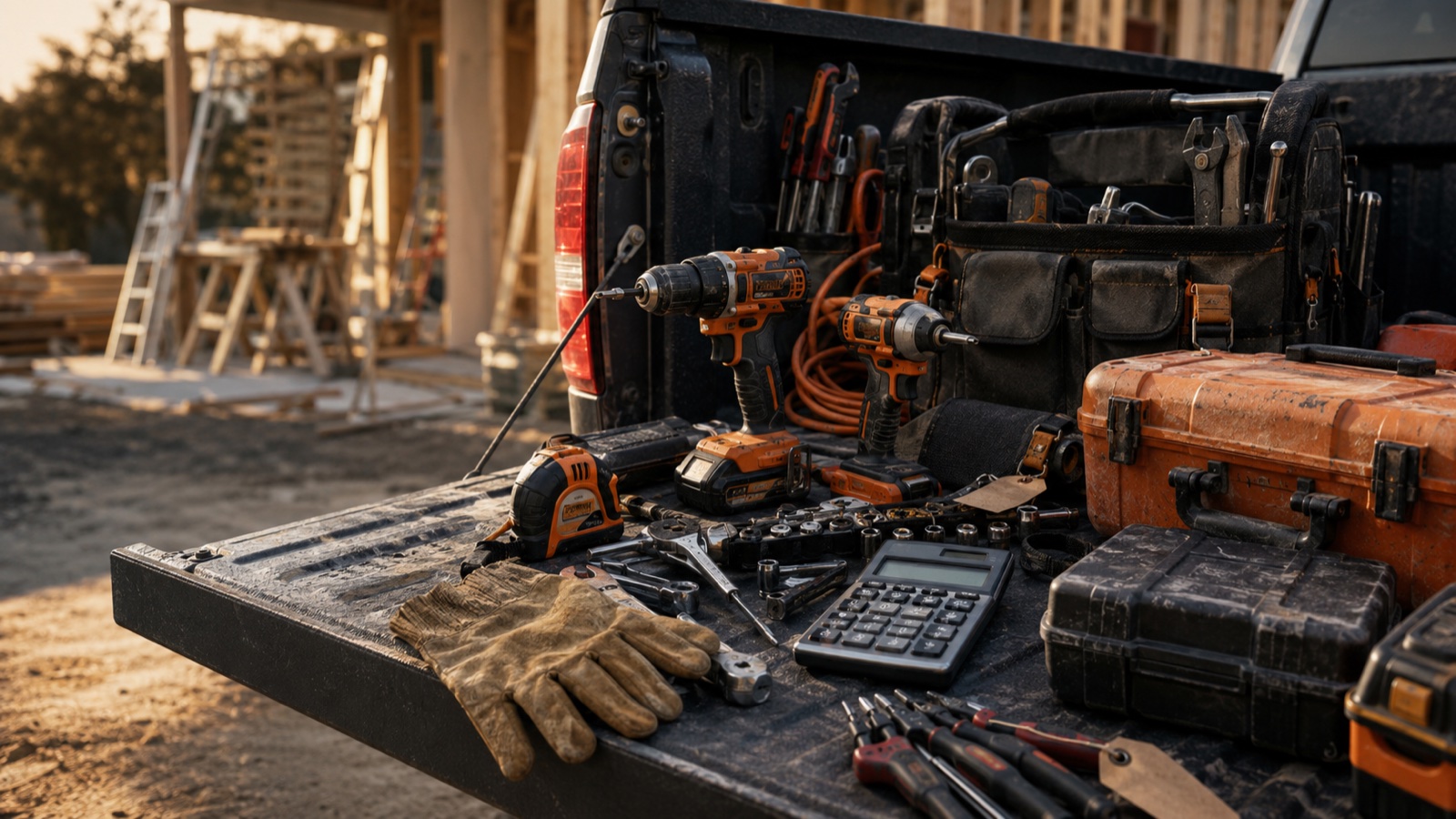
Ask a contractor how much their tools are worth and you'll usually hear something like "I don't know, maybe five grand?" Then you walk through the truck with them and start adding it up. The impact driver. The rotary hammer. The oscillating multi-tool. The sawzall. The circular saw. The three sets of drill bits. The socket set. The four levels. The laser. The headlamp. The knee pads. The tool bags themselves.
By the time you're done, that "five grand" is usually $12,000 to $20,000. Sometimes more.
Most contractors dramatically underestimate the replacement value of their tools. This matters for two reasons: it affects how much insurance coverage you carry, and it determines how much you get paid if something goes wrong.
Why the number is always higher than you think
There are a few psychological reasons contractors undervalue their tools.
You bought them over years. Nobody walks into Home Depot and drops $15,000 in one trip. You buy tools gradually — a new drill here, a set of wrenches there, a specialty tool for a specific job. Each purchase feels small. The total never registers.
You remember the sale price, not the replacement price. That Milwaukee M18 combo kit you got for $299 on Black Friday? It's $449 today. Replacement value is based on what it costs to buy the same tool new right now, not what you paid.
You forget the accessories. Bits, blades, batteries, chargers, cases, bags, extensions, adapters. A single cordless tool platform with three batteries, a rapid charger, and a dozen accessories can represent $200–$400 beyond the cost of the tool itself.
You don't count the cheap stuff. Hand tools, measuring tools, safety gear, consumables — individually they're $10–$50 each, but most contractors have dozens of them. A full set of hand tools for an electrician can run $500–$1,000. A plumber's hand tools are similar.
How to calculate your replacement value
The only accurate way is to actually count. Walk through every place you keep tools — your truck, your shop, your garage, your job site — and document every tool you see. For each one, look up what it costs to buy new today.
Here's a rough framework by trade to give you a starting point. These represent typical solo-operator toolkits, not bare minimums.
Electricians: $5,000–$15,000. This includes a cordless tool platform (drill, impact driver, rotary hammer, sawzall — roughly $800–$1,500 for the kit), testing equipment like multimeters and clamp meters ($200–$800 depending on brand), fish tape and pulling equipment ($100–$300), hand tools including multiple pliers, strippers, screwdrivers, and nut drivers ($500–$1,000), a conduit bender ($50–$200), and various specialty items.
Plumbers: $5,000–$20,000. Press tools alone can be $3,000–$5,000 (a Ridgid ProPress kit is north of $4,000). Add a cordless tool platform, a pipe wrench set, basin wrenches, tubing cutters, inspection camera ($300–$1,500), torpedo levels, and hand tools.
HVAC techs: $8,000–$25,000. Refrigerant recovery equipment ($500–$2,000), manifold gauge sets ($200–$600), vacuum pumps ($300–$800), leak detectors ($100–$400), plus the standard cordless tools, hand tools, and meters. Specialized diagnostic equipment can push the total significantly higher.
Carpenters and general contractors: $5,000–$15,000. Table saw ($300–$700), miter saw ($200–$600), circular saw ($100–$300), cordless platform, nail guns ($200–$400 each), hand tools, levels, squares, measuring tools, clamps. Finish carpenters with routers, planers, and joinery tools can be well above this range.
These are conservative estimates. If you've been in the trade for 10+ years, own premium brands, or have accumulated specialty tools, your total could be double.
Replacement value vs. actual cash value
Two terms you'll see on insurance policies:
Replacement cost value (RCV) means the insurer pays what it costs to buy the same tool new today. Your five-year-old DeWalt drill gets replaced with a new DeWalt drill at current retail price.
Actual cash value (ACV) means the insurer pays the depreciated value — what your used tool was "worth" at the time of loss. That same five-year-old drill might get valued at 40% of retail.
The difference is enormous. On a $15,000 toolkit, ACV coverage might pay out $6,000–$8,000 after depreciation. RCV coverage pays $15,000. The premium difference between the two is usually small. If you have the option, replacement cost coverage is almost always the better deal.
What to do with this number
Once you know your total replacement value:
Check your insurance limits. If you're carrying $10,000 in tools coverage but your actual replacement value is $18,000, you're underinsured by $8,000. That's $8,000 you'd have to pay out of pocket after a total loss. Call your agent and adjust your limits.
Document everything. A number is useful. A number backed by photos, serial numbers, and an itemized list is powerful. Build a proper inventory — either in a spreadsheet or using an inventory app — so you can prove what you own if you ever need to.
Update it regularly. Tool prices change. You buy new tools. You retire old ones. Review your inventory and your coverage limits at least twice a year.
Know your deductible. Most inland marine policies have deductibles of $250–$1,000. Factor that into your planning. A $500 deductible on a $15,000 loss is manageable. A $1,000 deductible on a $2,000 claim means you're eating half the loss.
The exercise that changes minds
If you've never actually tallied up your tools, do this: spend 15 minutes walking through your truck or shop. Pick up every tool and look up the current retail price on your phone. Keep a running total.
Most people hit their "oh shit" number within the first five minutes.
That number is why tool inventory apps exist. Not because organizing is fun, but because knowing what you'd need to spend to replace everything — and being able to prove it — is the difference between a bad week and a financial disaster.
ToolTracked calculates your total replacement value automatically as you scan your tools. The dashboard shows your running total, broken down by category and location. Free for up to 20 tools. Try ToolTracked →