Equipment Inventory for Small Construction Companies
You used to know where every tool was. Then you hired a second crew, and everything changed.
There's a phase every construction contractor goes through. You start solo. You know every tool you own because you bought them all and they're either on your truck or in your shop. You can picture exactly where your rotary hammer is right now.
Then business picks up. You hire a helper. Then another. You buy more equipment. You start running two crews, maybe three. Tools spread across multiple trucks, multiple job sites, and a shop that's turning into a warehouse.
And one day you realize you have no idea what you actually own anymore.
This is the point where most small construction companies develop an equipment problem — not because they're careless, but because the systems that worked for a solo operation collapse under the weight of growth.
The accountability gap
When it was just you, accountability was simple. You used a tool, you put it back. If something was missing, you knew where you left it.
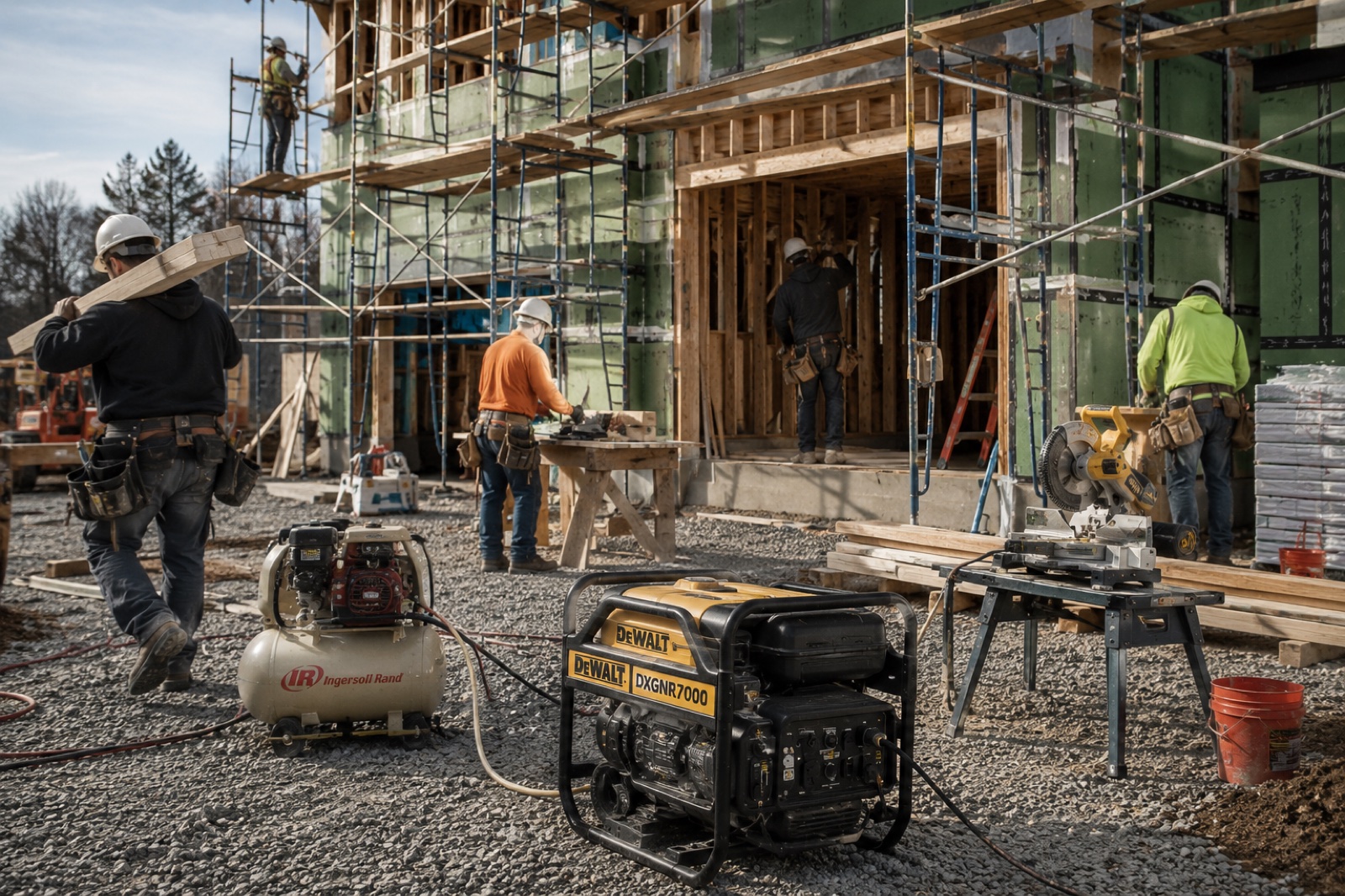
With multiple crews, accountability gets complicated fast. A generator goes to a job site on Monday and doesn't come back on Friday. Whose truck is it on? Who signed it out? Did anyone sign it out, or did someone just grab it? Is it at the Elm Street job or the warehouse renovation?
This isn't a trust problem. It's a systems problem. Your guys aren't stealing from you (probably). They're just doing what everyone does when there's no tracking system — they grab what they need and figure the rest will sort itself out. It doesn't sort itself out.
The fix is straightforward: every piece of equipment gets assigned to a person or a location, and any time it moves, the record gets updated. That sounds tedious until you compare it to the cost of buying a third set of extension cords because nobody can find the first two.
What to inventory: the major categories
Small construction companies tend to accumulate equipment in predictable categories. Here's what you should be tracking:
Power generation and air
- Generators (portable and towable)
- Air compressors
- Welding machines
These are your high-value, high-demand items. They move between job sites constantly, and they're expensive to replace. Every generator should have a record with its serial number, wattage, fuel type, and maintenance schedule. If you own three generators and can't tell me where all three are right now, that's your first problem to solve.
Scaffolding and access equipment
- Scaffolding frames, braces, and planks
- Ladders (extension, step, platform)
- Pump jacks and poles
Scaffolding is particularly tricky to track because it comes in pieces. You send 20 frames to a job, and 17 come back. The other three are "somewhere." Multiply that over a year and you've lost thousands of dollars in scaffolding components. Track it by set — how many frames, braces, planks, and base plates went out, and how many came back.
Power tools
- Circular saws, miter saws, table saws
- Drills and impact drivers
- Rotary hammers and demolition hammers
- Grinders, sanders, planers
- Nail guns and staple guns
- Concrete tools (vibrators, mixers, trowels)
Power tools are the bulk of most inventories. They range from $50 cordless drills to $2,000 rotary lasers, and they have a way of migrating between trucks and never coming home. Serial numbers are your best friend here. Record every one.
Safety equipment
- Hard hats, safety glasses, high-vis vests
- Fall protection harnesses and lanyards
- Fire extinguishers
- First aid kits
- Barricades, cones, and caution tape
Safety equipment is the category everyone forgets to inventory — until OSHA shows up. You need to know that every crew has the required safety gear, that harnesses are within their inspection dates, and that first aid kits are stocked. This isn't just about money; it's about keeping people alive.
Hand tools and consumables
- Levels, squares, tape measures
- Hammers, pry bars, chisels
- Shovels, rakes, wheelbarrows
- Extension cords and power strips
These are lower-value individually, but they add up. A well-equipped crew might have $2,000-$3,000 in hand tools. You probably don't need to track every tape measure by serial number, but you should have a count and a replacement value for insurance purposes.
The insurance gap nobody talks about
Here's the uncomfortable truth: most small construction companies are underinsured on their equipment.
It works like this. You start your business with $15,000 in tools and get an inland marine policy for $20,000 in coverage. Five years later, you've got $80,000 in equipment, but your policy still says $20,000 because you never updated it. You've been paying premiums on a policy that would cover less than a quarter of your actual loss.
This happens because nobody sits down and does a full count. Equipment accumulates gradually — a new saw here, a generator there, another set of scaffolding for the second crew. Each purchase feels small, but they compound.
The only fix is a complete inventory with current replacement values. Not what you paid for things — what it would cost to replace them today, at today's prices, which are probably higher than what you paid.
Once you have that number, call your insurance agent. If there's a gap between your coverage and your actual equipment value, close it. The premium increase is almost always small compared to the exposure you're carrying.
Building your inventory when you're already behind
If you haven't inventoried in years — or ever — the prospect of cataloging everything across multiple trucks, a shop, and several active job sites feels overwhelming. Here's how to make it manageable.
Start with the shop. Your shop or warehouse is the central hub. Everything passes through it eventually. Spend one Saturday morning walking through it with your phone, recording every piece of equipment. ToolTracked's AI photo scanning can speed this up significantly — snap a photo and let it identify the tool, brand, and model automatically instead of typing everything manually.
Then do the trucks, one at a time. Each truck is its own mini-inventory. Have the crew lead photograph everything on their truck. This doubles as a baseline — now you know what's supposed to be on each truck.
Then sweep the active job sites. Anything on a job site that isn't assigned to someone's truck gets recorded and assigned. This is where you'll find the "lost" equipment that's been sitting in a corner for three months.
Assign everything. Every piece of equipment should be assigned to a person, a truck, or a location. Unassigned equipment is equipment that's about to go missing.
The real cost of not tracking
I've talked to contractors who've lost $5,000, $10,000, even $20,000 in equipment over a year simply because nobody was keeping track. Not from theft — from disorganization. Duplicate purchases because no one knew they already owned something. Equipment left at completed job sites. Tools loaned to other contractors and never returned.
That's money straight off your bottom line. On a job with 10% margins, losing $10,000 in equipment means you need $100,000 in additional revenue just to break even on the loss.
An inventory won't make the problem disappear overnight. But it will make it visible, and visible problems are problems you can solve.
Make it part of your process
The companies that stay on top of their equipment don't do it through heroic annual inventory sessions. They make tracking part of the daily workflow. Tools get checked out in the morning and checked back in at night. New purchases get added to the system the day they arrive. Broken or worn-out equipment gets flagged for replacement.
It takes discipline, but so does everything else about running a construction company. And unlike a lot of business overhead, this one pays for itself almost immediately.
ToolTracked helps small construction companies track equipment across crews and job sites — with AI photo scanning, assignment tracking, and insurance-ready PDF reports. Get your inventory under control at tooltracked.com.