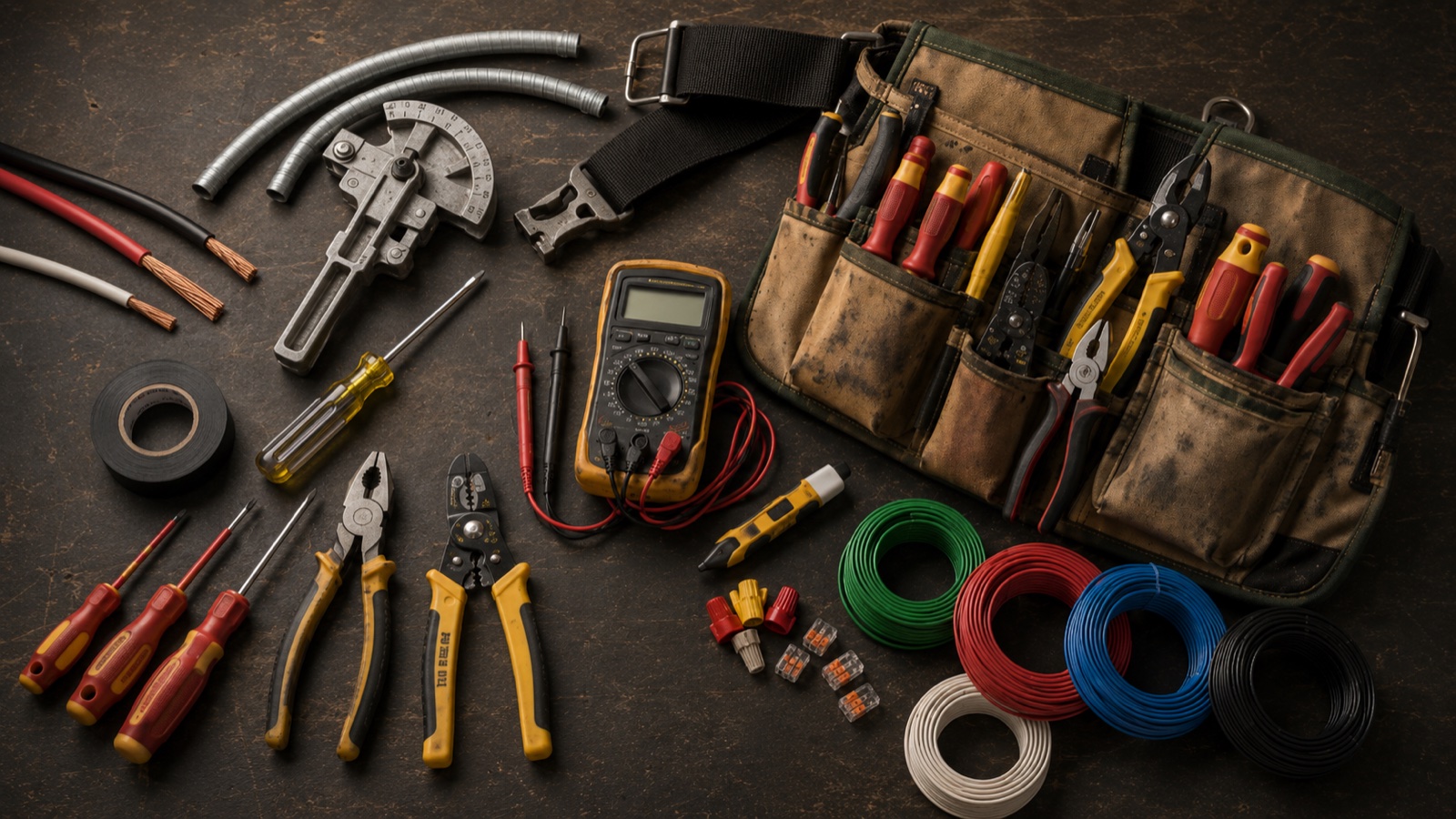
The Electrician's Guide to Tool Inventory
A complete walkthrough for electricians: what to inventory, how to value it, and why the small stuff adds up faster than you think.
Electricians accumulate tools differently than most trades. You start with a basic set of hand tools in your apprenticeship, pick up specialty items as you move into journeyman work, and by the time you've been in the trade for a decade, you're carrying around a small hardware store. Most of it was bought one piece at a time. Almost none of it has ever been counted.
This guide is specifically for electricians who want to build a proper tool inventory — whether for insurance, for your own records, or because you've seen one too many "my truck got broken into" posts in the Facebook groups and decided to finally document what you own.
What your toolkit is actually worth
Most electricians we talk to guess their tools are worth somewhere between $3,000 and $5,000. The actual number is almost always higher — typically $5,000 to $15,000 for a working journeyman, and up to $20,000+ for an electrician who's been in the trade for 15+ years or who does specialized work (industrial, fire alarm, low voltage).
Here's why the number surprises people: electricians carry a lot of mid-priced tools. You might not have a single tool over $500, but you have dozens of tools in the $30–$200 range, and they add up relentlessly.
The full inventory — what to count
Here's a comprehensive list organized by category. Use it as a checklist. Not every electrician carries everything on this list, but most carry more than they'd remember off the top of their head.
Cordless tool platform
This is usually the single biggest line item. A typical electrician's cordless setup on one battery platform (Milwaukee M18, DeWalt 20V MAX, Makita 18V LXT, etc.) might include:
- Drill/driver — $100–$180
- Impact driver — $100–$200
- Rotary hammer (SDS-Plus) — $150–$300
- Reciprocating saw — $100–$200
- Band saw (for cutting conduit and strut) — $200–$350
- Oscillating multi-tool — $100–$200
- Work light / area light — $50–$150
- Batteries (3–6 batteries at $80–$150 each) — $240–$900
- Charger(s) — $50–$100
- Carrying cases and bags
Total for cordless platform alone: $1,100–$2,600
Don't forget the batteries. They're the most commonly overlooked item in an electrician's inventory, and they represent a huge portion of the total value. Six Milwaukee M18 5.0Ah batteries at $130 each is $780 just in batteries.
Testing and diagnostic equipment
- Digital multimeter (Fluke 117 or similar) — $150–$300
- Clamp meter (Fluke 325 or similar) — $150–$350
- Non-contact voltage tester (NCVT) — $20–$40
- Circuit tracer / breaker finder — $50–$150
- Receptacle tester — $15–$30
- Megohmmeter / insulation tester (if you do industrial work) — $300–$1,500
- Phase rotation meter — $80–$200
- Thermal imaging camera (if applicable) — $200–$1,000
Total for test equipment: $500–$3,500
Your Fluke meter is probably the tool you'd miss most if it were stolen. It's also one of the easier tools to value — Fluke serial numbers are well-documented and prices are consistent.
Hand tools
This is where electricians really accumulate. A working electrician's hand tool collection commonly includes:
- Lineman's pliers (Klein 9-inch is standard) — $30–$50
- Diagonal cutters (multiple sizes) — $20–$40 each
- Needle-nose pliers (standard and bent) — $20–$35 each
- Channel-lock pliers (multiple sizes) — $15–$35 each
- Wire strippers (multiple types) — $20–$50 each
- Cable cutters — $30–$80
- Screwdriver set (insulated if you work on live circuits) — $50–$200 for a set
- Nut driver set — $30–$60
- Allen key sets (SAE and metric) — $15–$40
- Torpedo level — $20–$50
- Tape measure(s) — $15–$35 each
- Utility knife — $10–$25
- Hammer — $15–$40
- Hacksaw — $15–$30
- Reaming tool / deburring tool — $10–$25
- Voltage-rated hand tools (if you carry them) — premium pricing, $30–$80 per tool
Total for hand tools: $400–$1,000
Most of these are Klein, Knipex, Wera, or similar trade-grade brands. They're not cheap individually and you carry a lot of them.
Conduit and wiring tools
- Conduit bender(s) (1/2", 3/4", 1") — $40–$100 each
- Fish tape (steel and/or fiberglass) — $50–$150
- Fish sticks / glow rods — $40–$80
- Pulling rope — $20–$50
- Knockout punch set — $100–$300
- Step bit / Unibit set — $30–$80
- Hole saw kit — $50–$150
- PVC cutter — $15–$40
- Conduit reamer — $10–$30
Total: $300–$900
Safety and work gear
- Headlamp — $25–$80
- Safety glasses (multiple pairs) — $10–$30
- Hard hat — $15–$60
- Voltage-rated gloves (with leather protectors) — $50–$200
- Ear protection — $10–$30
- Knee pads — $20–$60
- Tool belt / pouch system — $50–$200
- Tool bag(s) — $50–$200
- Lockout/tagout kit — $30–$100
Total: $250–$800
Specialty items (not everyone carries these)
- Laser level — $80–$400
- Label maker (Brady, Brother) — $50–$200
- Inspection camera / borescope — $100–$400
- Cable pulling machine — $500–$2,000
- Wire cart — $100–$300
- Crimping tools — $50–$300
The running total
If you add up the midpoints of each category:
- Cordless platform: ~$1,800
- Test equipment: ~$1,200
- Hand tools: ~$700
- Conduit/wiring tools: ~$600
- Safety/work gear: ~$500
- Specialty: ~$400 (varies widely)
Typical total: ~$5,200 on the low end, $10,000–$15,000 for an experienced journeyman.
And that's before your truck or van setup — ladder racks, shelving, bins, and organizers can add another $500–$2,000.
How to build your inventory efficiently
Going through all of this manually — opening a spreadsheet, typing in every item, looking up every price — takes hours. Here are some tips to make it faster:
Work by location. Don't try to remember everything. Go to your truck and inventory the truck. Go to your shop and inventory the shop. Physical proximity is the best memory aid.
Start with the expensive stuff. Your cordless platform, your meters, your specialty tools. These represent the bulk of your replacement value and they're the most important items to document.
Don't skip the cheap stuff, but batch it. You don't need to individually price every screwdriver. Estimate your hand tool collection as a group if you need to: "Klein hand tool set, approximately 25 pieces, estimated replacement value $600."
Record serial numbers on power tools and meters. Every cordless tool, every Fluke meter, every laser level has a serial number. These are the items most likely to be stolen and most likely to be recoverable if you can prove ownership.
Take photos. A photo of each tool (or each tool bag laid out) is strong documentation. If you're using a tool inventory app, the photo is captured as part of the scanning process.
Insurance considerations for electricians
Most electricians carry a blanket inland marine policy rather than insuring tools individually. A few things specific to the trade:
Test equipment is expensive and often underinsured. A Fluke 87V multimeter is $400. A clamp meter is $300. An insulation tester can be $1,500. These items are easy to overlook when setting coverage limits.
Battery platforms appreciate in value. Seriously. If you bought into the Milwaukee M18 system five years ago, your batteries and tools have likely gone up in replacement cost, not down. Make sure your coverage reflects current retail prices, not what you paid.
Specialty tools may need to be scheduled. If you carry a cable pulling machine, a megohmeter, or other high-value specialty equipment, check whether your policy requires these to be listed individually (scheduled) for full coverage.
Company tools vs. personal tools. If you work for a company but supply your own tools (common in the trade), make sure you have your own inland marine policy. Your employer's insurance typically does not cover your personal tools.
Get started
The best time to inventory your tools was when you bought them. The second best time is now. Whether you use a spreadsheet, a notes app, or a dedicated tool tracking app, the goal is the same: know what you own, know what it's worth, and have the documentation to prove it.
ToolTracked's AI camera recognizes tools from Klein, Knipex, Fluke, Milwaukee, DeWalt, Makita, and hundreds of other brands electricians use daily. Point, snap, and it's inventoried — brand, model, and replacement value. Free for up to 20 tools. Download ToolTracked →