How to Document Tools for an Insurance Claim After Theft
Your tools are gone. Your livelihood just took a hit. Here's exactly what to do right now to get your insurance claim moving.
If you're reading this, there's a good chance you just walked up to your truck, your trailer, or your job site and found your tools missing. That sick feeling in your stomach is real. Those tools are how you make a living, and someone just took them.
Take a breath. You're going to get through this. But the next 48 hours matter more than you think for getting your insurance company to pay out. Here's what to do, step by step.
File the Police Report First
Before you call your insurance company, call the police. Every insurer requires a police report number before they'll process a tool theft claim. This isn't optional.
When the officer arrives (or when you go to the station), be as specific as possible. Don't say "a bunch of tools." Say "a Milwaukee M18 FUEL hammer drill, serial number XYZ, purchased March 2024." The more detail in the police report, the stronger your insurance claim becomes later.
If you can't remember exact details right now, that's okay. Give them what you can and ask if you can supplement the report later. Most departments allow amendments within a reasonable window.
Get the report number before the officer leaves. Write it down, take a photo of it, text it to yourself. You'll need it for every conversation from here on out.
Call Your Insurance Company Immediately
Don't wait until Monday. Don't wait until you "have everything together." Call your insurer the same day if possible. Most policies have reporting windows, and delays can give adjusters a reason to question your claim.
When you call, you'll need:
- Your policy number
- The police report number
- The date and approximate time of the theft
- The location where the theft occurred
- A general description of what was stolen
The rep will open a claim and assign you a claim number. Write this down too. You'll also get assigned an adjuster — they're the person who decides what you get paid. Be polite, be organized, and be honest. Adjusters handle fraud all day long, and they can tell when someone's inflating a claim.
Gather Every Piece of Documentation You Can Find
This is where most contractors either win or lose their claim. The insurer needs you to prove two things: that you owned the tools, and what they were worth.
Here's where to look:
Receipts. Check email for digital receipts from Home Depot, Lowe's, Milwaukee Tool, or wherever you buy. Search your inbox for order confirmations. If you buy from supply houses, call them — many keep purchase histories tied to your account.
Credit card and bank statements. Even without a receipt, a credit card charge at a tool retailer on a specific date helps establish a purchase. Log into your bank's website and download statements going back as far as you can.
Old photos. Scroll through your phone's camera roll. Job site photos, progress pics you sent to clients, even selfies in your truck — anything that shows your tools in the background counts. Check the metadata on those photos for dates and locations.
Warranty registrations. If you registered any tools with the manufacturer, that's gold. Milwaukee, DeWalt, Makita — they all keep records. Log into your accounts and screenshot everything.
Previous insurance documents. If you had a tool inventory on a previous policy or rider, that documentation still helps establish ownership even if it's from a different insurer.
What Makes a Strong Claim vs. a Weak One
Insurance adjusters see two kinds of claims: organized and chaotic. The organized ones get paid faster and closer to full value.
A strong claim has an itemized list with brand names, model numbers, and serial numbers where possible. It includes photos of the tools (ideally with timestamps). It has purchase documentation — receipts, statements, or registration records. And it lists replacement values, not what you paid five years ago.
A weak claim says something like "approximately $8,000 in assorted hand and power tools." No specifics. No photos. No proof of ownership. Adjusters don't deny these claims outright — they just pay out a fraction of what you lost because you can't prove the rest.
The difference between a $2,000 payout and a $12,000 payout on the same theft often comes down to documentation.
Be Honest About Values — But Know the Difference Between Purchase Price and Replacement Cost
Your policy likely covers replacement cost, not what you originally paid. That matters because tool prices go up. The drill you bought for $299 three years ago might cost $349 to replace today. Your claim should reflect current replacement prices.
Look up every stolen item on the manufacturer's website or at a major retailer. Document the current price for each tool. Your adjuster will verify these numbers, so don't inflate them — but don't shortchange yourself either.
If your policy covers actual cash value instead of replacement cost, that's a different calculation that accounts for depreciation. Check your policy language or ask your agent which coverage you have.
Document the Scene
Take photos of the break-in before you clean anything up. Broken locks, pry marks, smashed windows, cut cables — all of this supports your claim. If there's security camera footage from nearby businesses, ask for it. Time-stamped evidence of forced entry removes any doubt about whether a theft actually occurred.
Keep a Record of Every Conversation
From this point forward, write down every interaction with your insurance company. Date, time, who you spoke with, what was discussed, what they asked for. If they request documents, send them promptly and keep copies. Follow up phone calls with emails that summarize what was said.
This paper trail protects you if your claim gets delayed, disputed, or lowballed.
The Hard Lesson: Build Your Inventory Before You Need It
Here's the truth nobody wants to hear while they're in the middle of a crisis: the best time to document your tools was before they got stolen.
If you'd had a complete inventory — photos, serial numbers, purchase records, replacement values — this entire process would be a straightforward conversation with your adjuster instead of a frantic scramble.
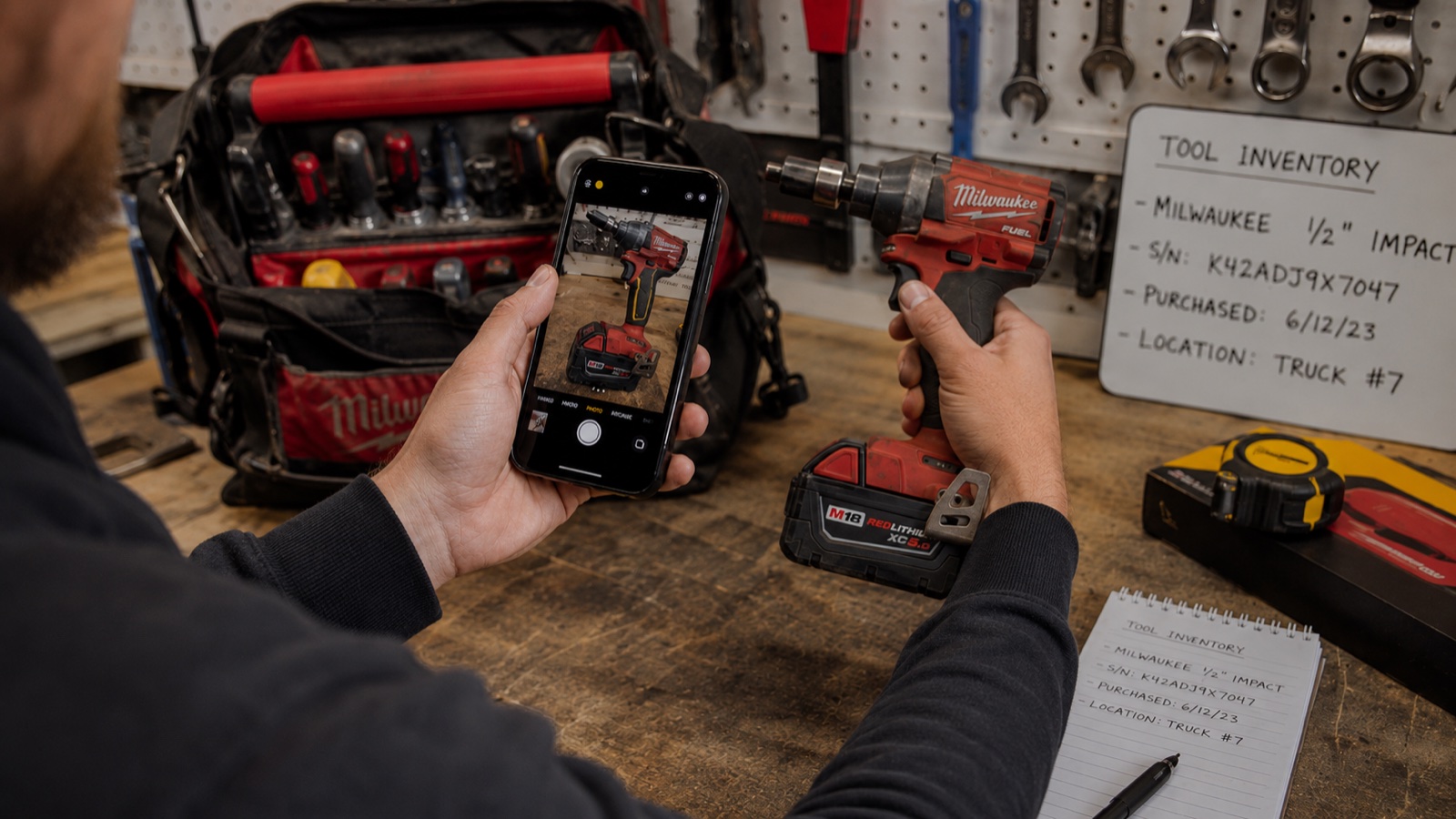
Once you replace your tools, build that inventory on day one. Take photos of every tool. Record serial numbers. Save receipts digitally. Apps like ToolTracked make this simple — snap a photo, and AI recognition helps catalog the tool automatically, including the documentation you'd need for exactly this situation.
The contractors who recover fully from theft aren't luckier than the ones who don't. They're just more prepared.
What to Do If Your Claim Gets Denied or Lowballed
If your insurer offers less than you think is fair, you have options. Ask the adjuster to explain their valuation in writing. Provide additional documentation if you have it. You can request a re-evaluation or file a complaint with your state's department of insurance.
For large claims, a public adjuster — someone who works for you, not the insurance company — can negotiate on your behalf. They typically charge 10-15% of the claim payout, but on a $20,000+ claim, they often recover more than enough to justify their fee.
Don't accept the first offer if it doesn't cover your losses. Adjusters expect negotiation.
Moving Forward
Getting robbed is a gut punch. But you're not the first contractor this has happened to, and the ones who come out okay on the other side all did the same things: they acted fast, they documented everything they could, and they stayed organized through the process.
Handle the next 48 hours well, and you'll put yourself in the best possible position to recover.
Don't wait for a theft to start documenting your tools. ToolTracked helps you build a complete, photo-verified inventory with AI recognition — so if the worst happens, you've got exactly what your insurance company needs to pay your claim fast.