DeWalt Tool Connect vs. Universal Inventory Apps
DeWalt's tracking system does some things really well — but it has hard limits. Here's an honest breakdown of where it fits and where it doesn't.
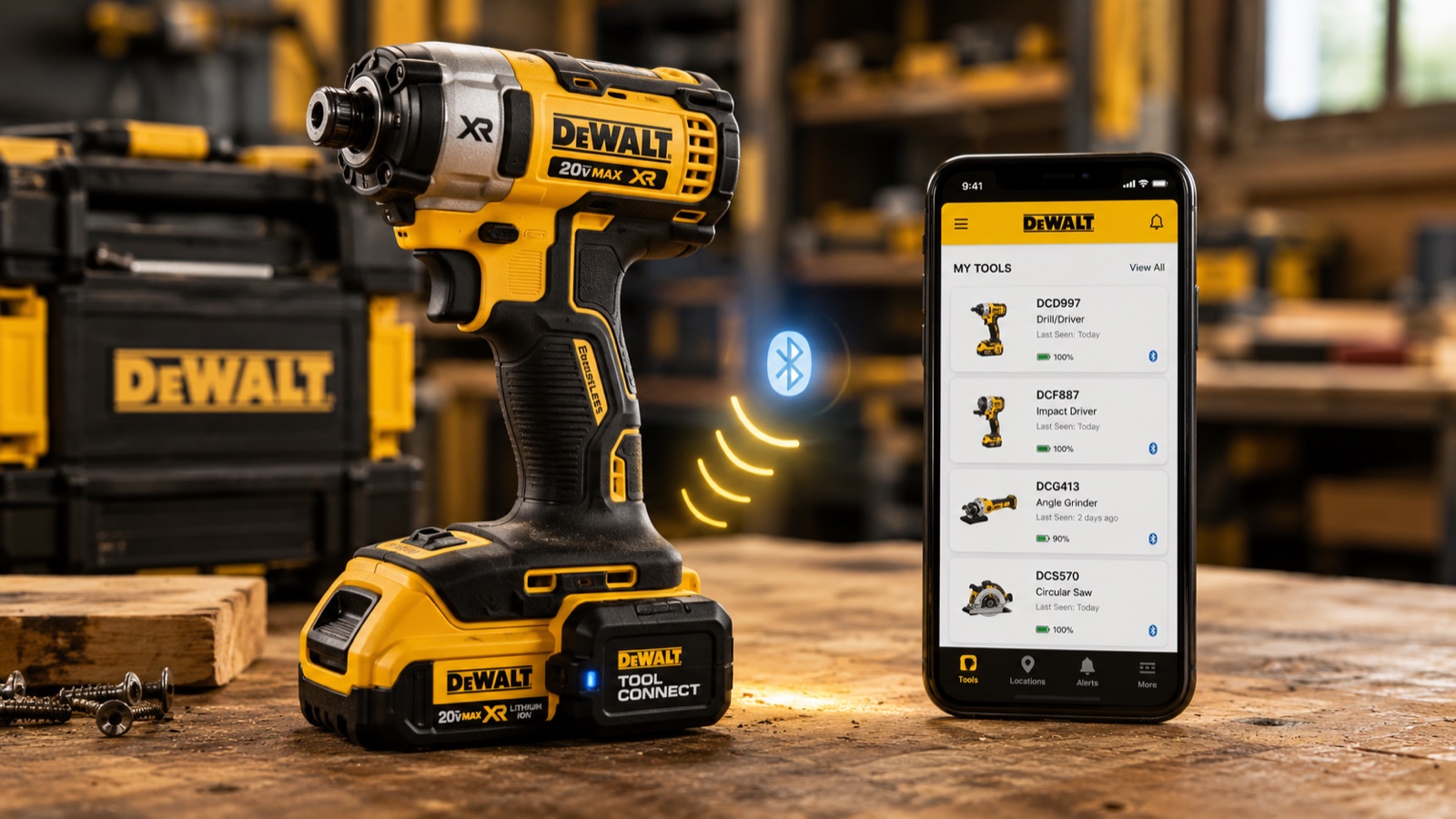
DeWalt Tool Connect launched as DeWalt's answer to the tool tracking problem. The promise: Bluetooth-enabled tools that communicate with your phone, letting you see where they are, manage your inventory within the DeWalt ecosystem, and keep tabs on your equipment.
If you run a lot of DeWalt gear, you've probably wondered whether Tool Connect is enough to cover your tracking needs. Maybe it is. But let's look at what it actually does before you decide.
What DeWalt Tool Connect offers
Bluetooth tracking. Like Milwaukee's One-Key, Tool Connect uses Bluetooth modules in compatible DeWalt tools to communicate with the app on your phone. Within Bluetooth range, you can ping a tool's location. If it's out of range, you see the last known position.
Inventory management. The Tool Connect app lets you catalog your DeWalt tools, view battery status, and organize tools by location or job site. For contractors running a fleet of DeWalt batteries across multiple tools, the battery health monitoring is a genuinely useful feature. Knowing which batteries are degrading helps you plan replacements before they fail on a job.
Customizable settings. On compatible tools, you can adjust performance parameters — speed, torque limits, trigger ramp-up — through the app. This is handy for applications where you need consistent, repeatable performance from your tools.
Tool usage tracking. Tool Connect logs run-time data, which gives you a picture of how hard your tools are working. This feeds into maintenance planning and can support warranty claims if a tool fails prematurely.
Lockout feature. If a tool is stolen, you can disable it through the app so it won't function. This is a deterrent more than a recovery tool — a thief can still sell the hardware — but it does make your stolen tools less useful to whoever took them.
Where Tool Connect runs into problems
DeWalt only. This is the dealbreaker for a lot of contractors. Tool Connect works exclusively with DeWalt tools. The Milwaukee impact in your truck? Invisible. Your Makita grinder? Doesn't exist. The $800 Bosch laser level? Not tracked.
Most contractors don't run a single-brand shop. Even contractors who prefer DeWalt usually have tools from other manufacturers scattered across their trucks and shops. Tool Connect creates an inventory of your DeWalt tools — which is a subset of your actual inventory.
Compatibility is limited even within DeWalt. Not every DeWalt tool supports Tool Connect. You need tools with the Bluetooth module built in, or you need to add a separate Tool Connect tag (an additional purchase). The compatible tool list has grown over the years, but plenty of DeWalt products — especially hand tools, older models, and lower-tier power tools — don't work with the system.
The app has mixed reviews. This is worth addressing directly. If you look at Tool Connect's app store reviews, the feedback is inconsistent. Some users report reliable Bluetooth connections and smooth operation. Others report connectivity issues, tools that drop off the network, and an interface that feels clunky compared to modern apps. DeWalt has improved the app over time, but the experience isn't universally smooth.
Bluetooth range limitations. Same constraint as any Bluetooth-based system: roughly 100 feet of range. That's fine for locating a tool in your shop. It doesn't help when a tool was left on a job site across town or was stolen overnight. The community tracking feature (where other Tool Connect users' phones can detect your tools) helps extend that range, but its effectiveness depends on how many Tool Connect users are in your area.
No insurance-grade documentation. Tool Connect can show you a list of your DeWalt tools in the app, but it doesn't generate the kind of formatted PDF reports that insurance companies want when you file a claim. An insurance adjuster needs photos, serial numbers, purchase dates, and replacement values in a clean, portable format. Tool Connect wasn't built for that workflow.
No coverage for vehicles, trailers, or non-tool equipment. Contractors don't just own power tools. They own trucks, trailers, generators, compressors, scaffolding, ladders, safety equipment, and specialty items. Tool Connect tracks none of this. A complete asset inventory needs to include everything — not just the items with a DeWalt logo.
What universal inventory apps do instead
Standalone tool tracking apps take a different approach entirely. Instead of embedding tracking hardware in specific tools from one manufacturer, they use your phone's camera and AI to catalog everything you own.
Every brand, every tool, every piece of equipment. A universal app treats your DeWalt drill and your Milwaukee saw and your Hilti anchor and your twenty-year-old Craftsman wrench set equally. They're all items in your inventory. No brand restrictions, no compatibility requirements.
AI photo recognition. Point your camera at a tool and the app identifies it — brand, model, category — without manual data entry. ToolTracked uses this approach to make building an inventory fast enough that you'll actually do it. The biggest barrier to tool tracking isn't technology; it's the tedium of typing in 200 tool names manually. AI identification removes that barrier.
Insurance PDF reports. This is the capability that matters when things go wrong. A universal app generates a complete inventory report — with photos, serial numbers, and replacement values — in a format your insurance company can process immediately. One tap, one PDF, done.
Complete asset coverage. Track your truck. Track your trailer. Track your table saw and your laser level and the $40 pry bar you'd miss more than you think. Everything that has value belongs in the inventory.
No special hardware. You don't need Bluetooth modules, compatible tool models, or add-on tags. You need a phone. That's it.
The tradeoffs
Let's be straightforward about what universal apps don't do.
No real-time location. A universal inventory app can't tell you which room your drill is in right now. It tracks what you own, not where it currently sits. If real-time tool location is critical to your operation — and it is for some larger crews — an inventory app doesn't replace that.
No performance customization. You can't adjust your drill's torque curve through an inventory app. That's a fundamentally different feature set.
No usage telemetry. Run-time data, battery cycle counts, and maintenance predictions aren't part of a universal inventory app's scope.
Who should use what
You're a DeWalt-dominant shop with 10+ employees. Tool Connect has real value for you. The ability to track tool locations across job sites, monitor battery health, and assign tools to crew members solves operational problems. But you still need a separate solution for insurance documentation and for tracking everything that isn't DeWalt.
You're a small crew or solo contractor with mixed brands. Start with a universal inventory app. Your immediate need is knowing what you own, what it's worth, and being able to prove it. Real-time Bluetooth tracking is a luxury; insurance documentation is a necessity.
You've been burned before. If you've already lost tools to theft, had an insurance claim denied for lack of documentation, or watched thousands of dollars evaporate because you couldn't prove what was in your truck — you know why a complete inventory matters. An app that covers everything you own and generates the reports your insurer needs is where you start.
Can you use both?
Yes, and some contractors do. Tool Connect manages your DeWalt tools day-to-day on job sites. A universal app like ToolTracked manages your complete inventory for insurance, taxes, and financial tracking.
The two systems don't conflict. They address different aspects of the same problem. Tool Connect is operational — where are my tools right now? A universal app is financial — what do I own and can I prove it?
If you can only choose one, choose based on your biggest risk. For most independent contractors, the risk of a tool theft or loss without documentation is more financially damaging than the inconvenience of not knowing which shelf a drill is on. Insurance claims without documentation get delayed, reduced, or denied. That costs real money.
The bottom line
DeWalt Tool Connect is a solid tool management system within the DeWalt ecosystem. The Bluetooth tracking, battery monitoring, and lockout features are genuinely useful innovations.
But it's not a complete inventory solution. It's a partial one — limited to one brand, dependent on compatible hardware, and missing the insurance documentation capability that contractors need most when things go sideways.
A universal inventory app fills the gaps Tool Connect leaves. No brand restrictions, no hardware requirements, and the PDF reports that turn a stressful insurance claim into a straightforward process.
ToolTracked tracks every tool in your truck — regardless of the logo on it. AI-powered photo recognition, serial number scanning, and one-tap insurance PDF reports. See how it works at tooltracked.com.