Carpenter's Guide to Tracking Woodworking Tools
You own more tools than anyone else on the job site. That's the problem.
Carpenters have a volume problem that no other trade quite understands. An electrician might carry 50 to 80 tools. A plumber, maybe 60 to 100. A working finish carpenter can easily own 200 to 400 individual tools — and that's before counting every chisel, every bit, and every blade in every set.
It's not just the power tools, either. Carpenters are the trade most likely to accumulate hand tools over decades, to own vintage pieces bought at estate sales, and to carry tools with genuine sentimental value alongside the Milwaukee and DeWalt battery platforms. Your grandfather's block plane sits in the same truck as a $600 miter saw.
This guide is for carpenters who know they should be tracking their tools but haven't because — honestly — where do you even start when you own that many?
What your toolkit is actually worth
The typical carpenter's guess: $5,000 to $10,000. The actual range for a working finish carpenter or cabinet maker: $10,000 to $30,000. Framing carpenters tend to land lower, around $5,000 to $12,000, but still higher than they think.
The math is relentless. A miter saw is $300 to $700. A table saw is $400 to $2,500. A planer is $300 to $600. A router with a set of bits is $200 to $500. A track saw system is $400 to $700. None of these are extravagant purchases — they're standard equipment for anyone doing finish work — but add them up and you're at $2,000 to $5,000 before you've counted a single hand tool, clamp, or accessory.
And carpenters buy accessories like nobody else. Router bit sets, dado blade sets, jigs, templates, specialty blades — the supporting cast costs almost as much as the main tools.
The full inventory — power tools
Major stationary and bench tools
These are the big-ticket items, whether they live in a shop or travel to job sites:
- Table saw (DeWalt DWE7491, SawStop, Bosch 4100) — $400–$2,500
- Miter saw / compound sliding miter saw (DeWalt DWS780, Makita LS1019L, Bosch GCM12SD) — $300–$700
- Miter saw stand — $100–$300
- Planer (DeWalt DW735, Makita 2012NB) — $300–$600
- Jointer (if shop-based) — $300–$1,500
- Band saw — $200–$800
- Drill press (if shop-based) — $150–$500
- Bench grinder — $50–$150
Total for major tools: $1,800–$7,000
Portable power tools
- Track saw / plunge saw (Festool TS 55, Makita SP6000J, DeWalt DWS520) — $350–$700
- Track / guide rail (multiple lengths) — $50–$200
- Circular saw — $100–$250
- Jigsaw — $100–$250
- Router (fixed base and plunge) — $150–$350
- Router table — $100–$400
- Router bit set — $50–$300
- Palm sander / random orbit sander — $50–$150
- Belt sander — $80–$200
- Detail / finish sander — $50–$100
- Biscuit joiner / plate joiner — $100–$300
- Domino joiner (Festool DF 500) — $1,000–$1,200
- Brad nailer (cordless or pneumatic) — $100–$300
- Finish nailer — $150–$350
- Framing nailer (if applicable) — $200–$400
- Pin nailer — $80–$200
- Compressor and hose (if pneumatic) — $150–$400
Total for portable power tools: $2,000–$5,500
A Festool Domino joiner by itself costs as much as some tradespeople's entire cordless platform. If you own one, it absolutely needs to be documented.
Cordless tool platform
- Drill/driver — $100–$180
- Impact driver — $100–$200
- Reciprocating saw — $100–$200
- Oscillating multi-tool — $100–$200
- Work light — $50–$150
- Cordless circular saw (if applicable) — $150–$300
- Cordless jigsaw (if applicable) — $100–$250
- Batteries (4–8 at $80–$150 each) — $320–$1,200
- Charger(s) — $50–$100
Total: $1,100–$2,800
The full inventory — hand tools
This is where carpentry splits from every other trade. The hand tool collection isn't just functional — for many carpenters, it's personal.
Measuring and layout
- Tape measures (multiple) — $15–$35 each
- Combination square(s) (Starrett, Empire, PEC) — $20–$150 each
- Speed square — $10–$25
- Framing square — $15–$40
- Marking gauge(s) — $15–$80 each
- Marking knife — $15–$50
- Bevel gauge / sliding T-bevel — $15–$40
- Chalk line — $10–$25
- Laser level — $80–$400
- Laser distance measurer — $50–$150
- Precision straightedge — $20–$80
- Architect's scale / ruler — $10–$30
- Pencils, markers, and sharpeners (they count)
Total: $300–$1,000
Chisels and carving tools
- Bench chisel set (1/4" through 1-1/2") — $40–$300 for a set
- Mortise chisels — $30–$80 each
- Paring chisels — $30–$60 each
- Specialty chisels (corner, skew, fishtail) — $20–$60 each
- Mallet — $20–$60
- Sharpening stones / system (Shapton, Norton, DMT) — $50–$400
Total: $200–$1,000
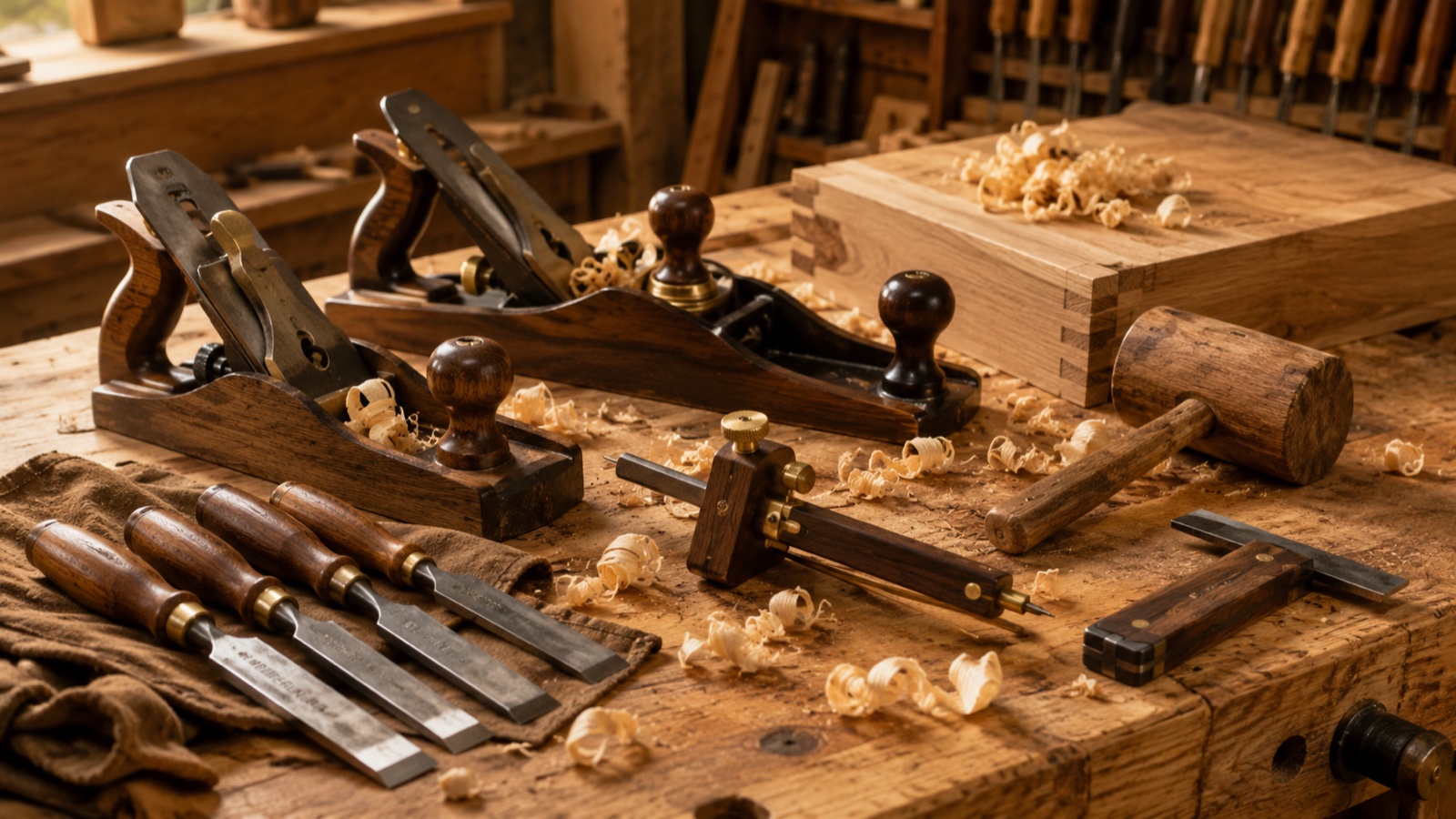
A set of Lie-Nielsen bench chisels costs $300. A vintage set of Marples or Stanley chisels from your mentor might be irreplaceable at any price. Both deserve to be documented.
Planes
- Block plane (Stanley No. 60-1/2, Lie-Nielsen) — $40–$175
- Smoothing plane (No. 4) — $40–$350
- Jack plane (No. 5) — $50–$350
- Jointer plane (No. 7 or 8) — $60–$400
- Shoulder plane — $50–$250
- Router plane — $40–$200
- Rabbet plane — $40–$200
- Spoke shave — $20–$100
Total: $300–$2,000
Planes are the tool category where sentimental and financial value overlap most. A well-tuned vintage Stanley No. 4 might be worth $50 on eBay but it's worth ten times that to the carpenter who's been using it for 20 years. For insurance purposes, track replacement cost — but for your own records, note the provenance too.
Saws (hand)
- Dovetail saw — $25–$150
- Tenon saw — $25–$150
- Japanese pull saws (multiple) — $20–$60 each
- Coping saw — $10–$30
- Flush-cut saw — $15–$40
Total: $100–$500
Clamps
Carpenters own more clamps than they can count. Literally.
- Bar clamps / F-clamps (10–30 of them) — $15–$40 each
- Parallel jaw clamps (Bessey K-Body, Jet) — $40–$80 each
- Pipe clamps — $15–$30 each (plus pipes)
- Spring clamps (a drawer full) — $3–$10 each
- Corner clamps — $15–$50 each
- Band clamps — $15–$40 each
- Toggle clamps — $10–$25 each
Total: $300–$2,000
If you own 20 Bessey K-Body clamps at $60 each, that's $1,200 in clamps alone. Clamps are the most under-counted category in every carpenter's inventory.
Other hand tools
- Hammer(s) — framing, finish, dead-blow — $15–$60 each
- Nail sets — $5–$15 each
- Pry bars (multiple sizes) — $10–$30 each
- Utility knives — $10–$25 each
- Files and rasps — $10–$40 each
- Scraper set — $10–$40
- Awl — $10–$25
Total: $100–$300
The running total
- Major power tools: ~$3,500
- Portable power tools: ~$3,500
- Cordless platform: ~$1,800
- Measuring/layout: ~$500
- Chisels: ~$500
- Planes: ~$800
- Hand saws: ~$250
- Clamps: ~$1,000
- Other hand tools: ~$200
Typical total: ~$12,000 for a working finish carpenter. $18,000–$30,000 for a well-equipped shop owner or custom furniture maker.
How to tackle 300+ tools
The sheer number is what stops most carpenters from ever building an inventory. It feels like a weekend project, and who has a free weekend?
Here's the approach that actually works:
Do it in 20-minute sessions, not one marathon. Open your miter saw case, photograph the saw, photograph the serial number, log it. That took two minutes. Tomorrow, do the table saw. The day after, lay out your chisels on the bench and photograph the set. In two weeks of short sessions, you'll have the whole shop documented.
Use categories, not individual entries for small items. You don't need to log every spring clamp individually. "Spring clamps, approximately 20 pieces, estimated replacement value $100" is fine. Save the individual entries for tools over $25 to $50 in value.
Photograph sets together. Your chisel set, your router bit collection, your clamp wall — photograph them as groups. One photo of 15 chisels laid out on a bench is better documentation than trying to remember each one individually. ToolTracked can scan multiple tools in a single photo, which turns a 300-tool inventory from an ordeal into something you can finish in a few evenings.
Start with irreplaceable items. If your grandfather's block plane got stolen, you could never replace it. Photograph it now. Document it now. The vintage and sentimental pieces should be first priority because they're the ones where the loss isn't just financial.
Don't forget consumables with holders. Your router bit set in its wooden case, your dado blade set in its box, your collection of specialty saw blades — these are stored items with real value that get overlooked.
Insurance for carpenters
The volume problem applies to claims too. After a theft, your insurance company will ask for a list of what was taken. If you can't produce one, you're relying on memory to reconstruct hundreds of items. Most people recover 40% to 60% of what they actually lost because they simply can't remember everything.
Shop vs. vehicle coverage. If you have tools in a shop and a truck, make sure your policy covers both locations. Some inland marine policies are vehicle-specific.
Vintage and collectible tools. Standard replacement cost coverage works for modern tools. But if you own vintage Lie-Nielsen, Veritas, or antique Stanley planes, their market value might exceed the "equivalent new item" replacement. Discuss scheduling high-value or collectible tools with your agent.
Tool sets vs. individual items. If one chisel from a matched set is stolen, you might need to replace the whole set to have a matching collection. Some policies cover sets differently than individual items.
ToolTracked's AI camera can scan an entire workbench of tools in one photo — chisels, planes, clamps, and all. It recognizes brands like Festool, Lie-Nielsen, Starrett, DeWalt, and hundreds more, logging brand, model, and replacement value automatically. Free for up to 20 tools. Download ToolTracked →